
Smokeball’s integration marketplace shows how legal tech ecosystems should work
A masterclass in excellence.

If you’re building an integration marketplace, you already know the hard part isn’t launching it. It’s making it matter.
Too many marketplaces turn into long lists of tools with unclear relevance, low adoption, and little impact on the core product. That’s especially common in vertical SaaS, where workflows are specific and the cost of noise is high.
That’s why the way Smokeball approaches its integration marketplace stands out.
They didn’t optimize for volume. They optimized for relevance, discovery, and fit. The result is an ecosystem that actually helps law firms get more value out of the product, not just a place to host logos.
This isn’t just a strong marketplace. It’s a blueprint for how legal tech ecosystems should actually work.
Why ecosystem discovery matters more than ever
Integrations extend your product, but discovery determines whether they get used.
If users can’t quickly tell which tools apply to their workflow, geography, or firm type, the marketplace becomes background noise. In legal tech especially, relevance isn’t a nice-to-have. It’s table stakes.
Smokeball treats discovery as a product experience, not an afterthought. Every design and distribution decision reinforces that mindset.
What Smokeball gets right
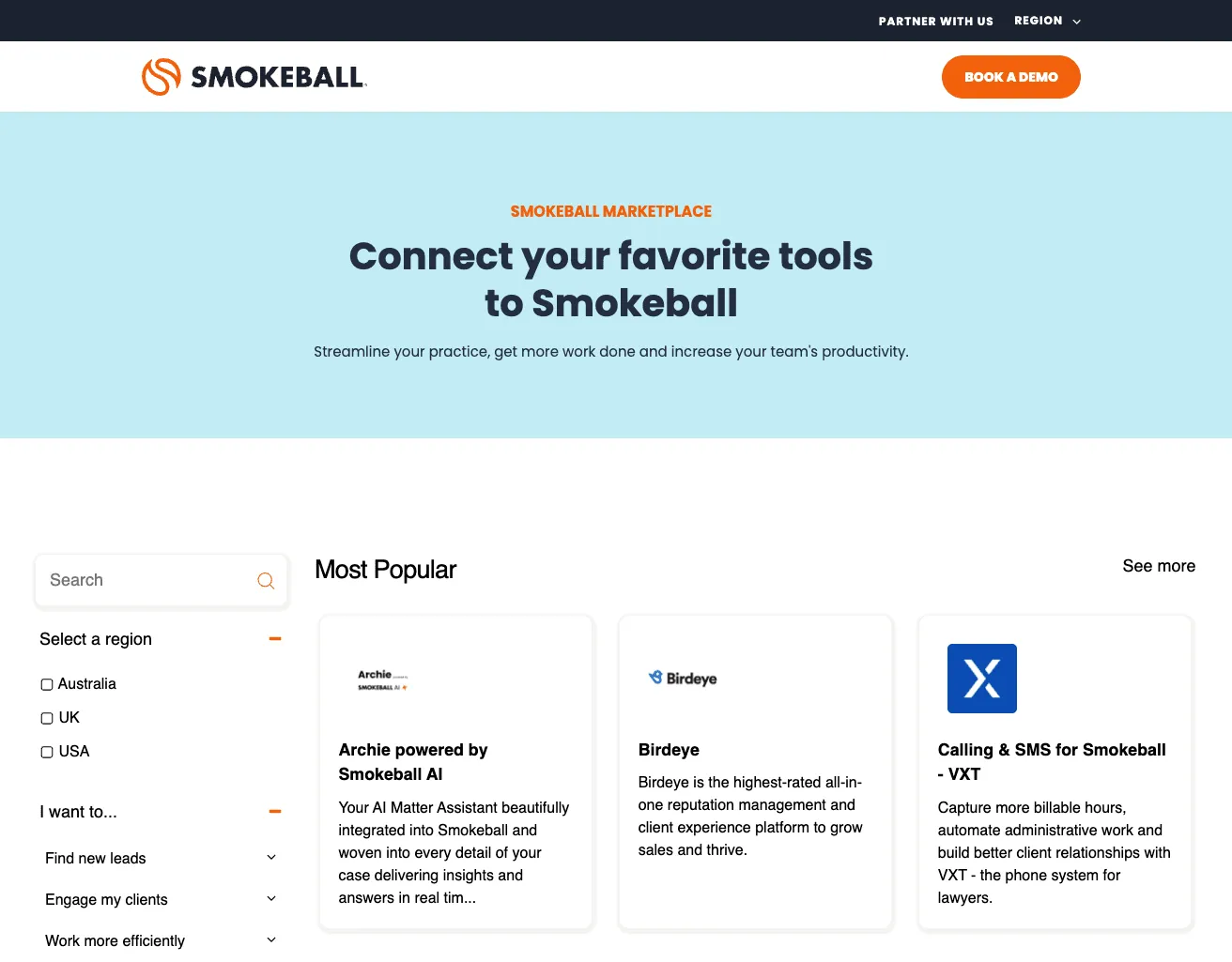
Localized by region without fragmenting the ecosystem
Smokeball serves firms across the US, UK, and Australia, and their marketplace adapts accordingly. Users see integrations that make sense for their jurisdiction, tooling landscape, and local workflows, all within the same underlying ecosystem.
This avoids the common trap of one global list that feels half-irrelevant to everyone.
What to learn from this: relevance scales better than one-size-fits-all marketplaces.
Available both on the website and in-product
Discovery doesn’t happen in one place. Smokeball’s marketplace lives on their public site and inside the product, which means users can explore integrations whether they’re evaluating the platform or already deep in daily work.
That dual distribution reinforces integrations as part of the core experience, not a bolt-on.
What to learn from this: where discovery happens is just as important as what you list.
Build a smarter marketplace
Learn how leading SaaS teams design app marketplaces that drive adoption, not just listings.
Get the guide
Designed to be clear, not clever
The marketplace design is simple, original, and easy to navigate. It avoids the clutter and generic layouts that make many marketplaces hard to scan.
Good design here isn’t about aesthetics. It’s about helping users understand value quickly.
What to learn from this: clarity drives adoption more than density.
Signals what’s new without overwhelming users
Clear tags for new integrations give the ecosystem momentum. Users can easily spot what’s been added without re-learning the entire marketplace each time they visit.
It’s a small detail that reinforces trust and progress.
What to learn from this: lightweight signals can drive ongoing engagement.
Built on infrastructure that supports scale
Smokeball has more than doubled its integrations in the last 1.5 years. That kind of growth requires more than good intentions. It requires systems that make partner onboarding, listing management, and updates repeatable.
Their marketplace is powered by Partner Fleet, which enables that scale without turning integrations into an engineering bottleneck.
What to learn from this: ecosystem velocity depends on infrastructure, not heroics.
CTAs that serve users and partners
Every listing guides action. Users can explore next steps with a partner, book a Smokeball demo, or express interest in becoming a partner themselves.
That balance turns the marketplace into a growth surface, not just a reference page.
What to learn from this: marketplaces should create paths forward, not dead ends.
What legal tech teams can take from this
Smokeball’s integration marketplace works because it respects the user’s time. It prioritizes relevance, contextual discovery, and ecosystem quality over raw numbers.
In a category where many platforms treat integrations as a checklist item, Smokeball treats them as a competitive advantage.
That’s the difference between having a marketplace and leading an ecosystem.
See it live
Explore how teams build scalable, discovery-driven integration ecosystems with Partner Fleet.
Book a demo
Keep reading
Browse all posts
Partner Fleet launches In-App Marketplace, bringing integration adoption inside the product
The new module gives companies a conversion-optimized integration experience for their customers, plus the analytics to prove what integrations are worth.

Partnerships in 2026: Retention is the real growth lever
Get it right early, and you'll have a great year.

How Mindbody built the #1 integrations marketplace in fitness tech
A powerhouse company with a powerhouse marketplace.