Is it a partner portal or a developer portal? Here’s how to tell
Learn which tool best serves your tech partner ecosystem.
You’re building an integration ecosystem. Maybe you’re a head of partnerships trying to onboard and activate tech partners, or an API Product Manager working to improve the developer experience and get integrations live faster. Either way, you’ve probably heard the terms “partner portal” and “developer portal” used interchangeably. And if you’re like most people, you’ve probably wondered whether they’re basically the same thing.
They’re not.
The two portals serve different audiences, solve different problems, and exist for different stages of your ecosystem. Mixing them up often leads to wasted engineering time, stalled integrations, and partners who lose momentum because they simply don’t have the right tools.
Let’s unpack the difference so you can make the right call for your program — whether you’re building, buying, or trying to modernize what you already have.
What is a partner portal?
A partner portal is the command center for the business side of your relationships. It’s built for sales, marketing, success teams, channel partners, and even the GTM side of your tech partners. The goal is to help those partners sell better, market more effectively, and report on activity and revenue.
Most partner portals provide a mix of sales enablement materials, co-marketing assets, deal registration workflows, lead-sharing tools, partnership performance dashboards, training and certification paths, and a communications layer. The experience is designed around joint go-to-market motions, not product integration. It’s where partners go to learn how to sell with you, how to talk about your product, how to access approved messaging and logos, and how to report opportunities so there’s no channel conflict.
In other words: a partner portal exists to scale GTM with external organizations. It’s about revenue, not repositories.
What is a developer portal?
If the partner portal is the front door, the developer portal is the technical workshop. It’s a self-service environment for engineers to explore your APIs, test against your platform, and move from discovery to working integration without needing to sit on your backlog or wait for your team.
A strong developer portal goes beyond documentation. It includes API references, interactive docs, API key management, sandboxes, SDKs and sample code, tutorials, changelogs, FAQs, and often a formal workflow for submitting integrations for review and publication. It is built to reduce friction in the build process and remove bottlenecks that would otherwise fall on your product or engineering team.
Where a partner portal helps partners sell, a developer portal helps them build. It is entirely focused on enabling technical users — whether they work for a tech partner, a customer, or an independent developer — to get from “I want to build something on your platform” to “I shipped an integration” as fast as possible.
See the Partner Fleet portal?
Log into to see the back end for yourself.
Try the Partner Fleet Playground
So what’s the difference?
The most important distinction is the audience. Partner portals serve business users. Developer portals serve developers. These two groups have very different goals, workflows, and expectations, and trying to squeeze both into the same system almost always leads to one group being underserved.
You can think about the difference this way:
If your product was a car, the partner portal is the showroom where sales teams get trained and equipped to sell it. The developer portal is the garage where engineers get trained and equipped to build new parts for it.
Both are part of your ecosystem, but they’re built for different jobs.
Can you use a partner portal for developers?
Only at the most superficial level. You can host high-level API information or link out to docs, but without the core infrastructure — interactive documentation, auth flows, sandboxes, code samples, submission paths — partners will stall. Developers don’t just need information; they need tools. And partner portals are built around sales workflows, not build workflows.
This is why attempts to “shoehorn developers into the partner portal” usually fail. They can find the PDFs, but they can’t build anything end-to-end.
Can you use a developer portal for partners?
This is where it gets more nuanced. For technology partners, the primary relationship with your company is the integration itself. So you can include deal registration and co-brandable pitch decks as a resource. But primarily they need a place to learn the API, experiment, build, test, submit, and ship.
And that means your developer portal often is the partner portal for your integration partners.
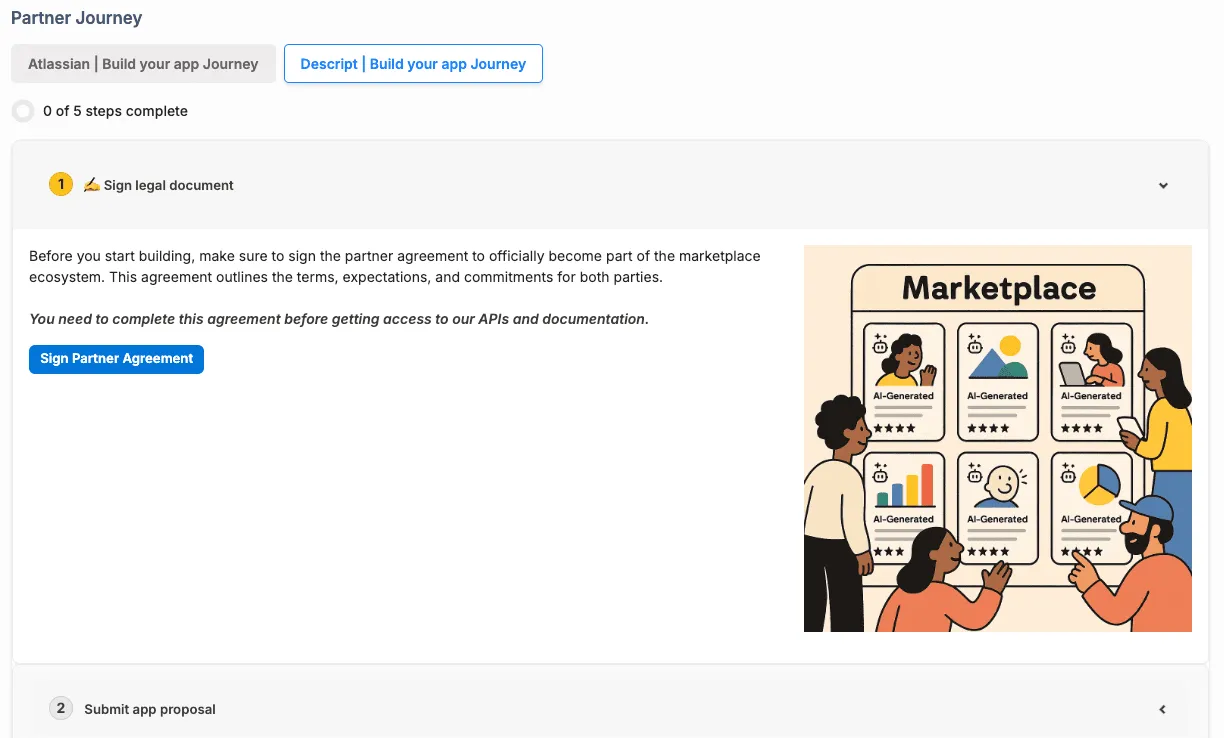
At Partner Fleet, this is exactly how we designed our developer portal. Developers can log in, explore APIs and documentation, spin up a sandbox, build against your platform, and then submit the finished integration for approval — all before publishing to your marketplace. For tech partners, that’s the entire relationship. Everything they need to build and launch lives in one environment.
The only time you’d need a formal partner portal in addition to a developer portal is when you’re also running a channel, affiliate, agency, or referral program that requires GTM workflows like deal reg, payouts, and marketing enablement.
Where do you get a partner portal or developer portal?
You have two broad paths:
Build in-house: Great for control, but expensive to build and even harder to maintain. Developer portals in particular require constant updates, documentation refreshes, and investment in usability — which is why most companies underestimate the ongoing cost by a wide margin.
Buy a specialized platform:
PRMs handle the traditional partner portal use case for channel and GTM partners.
Developer portals handle the technical build experience for API-based ecosystems.
Partner Fleet gives you the developer portal for integration partners and the app marketplace to showcase those integrations publicly and in-product — without relying on engineering every time something changes.
Compare building vs buying
Get our calculator for the cost to build a developer portal and marketplace in-house.
Download the guide
The right tool for the right job
Understanding the difference between these two portals isn’t just a terminology exercise. If you want your ecosystem to grow — through better integrations, faster partner activation, and a healthier developer experience — you need the right tools for the right personas. A partner portal helps business partners sell. A developer portal helps technical partners build. And both, when used correctly, multiply your ecosystem’s reach.
Ready to scale integrations without overwhelming your product and engineering teams?
Book a demo
Keep reading
Browse all posts
Partner Fleet launches In-App Marketplace, bringing integration adoption inside the product
The new module gives companies a conversion-optimized integration experience for their customers, plus the analytics to prove what integrations are worth.
Partnerships in 2026: Retention is the real growth lever
Get it right early, and you'll have a great year.
How Mindbody built the #1 integrations marketplace in fitness tech
A powerhouse company with a powerhouse marketplace.