
Don’t build from scratch: the case for an app marketplace builder
In B2B SaaS, a standalone product is a liability.

In B2B SaaS, a standalone product is a liability.
Your customers expect integrations. Your partners expect distribution. Your leadership expects ecosystem ROI. An app marketplace is no longer optional if you want to scale adoption and stay competitive.
The real question isn’t whether you need one. It’s how you build it without draining engineering time or shipping something that stalls after launch.
This post breaks down why an app marketplace matters, who it actually serves, and why using an app marketplace builder is the fastest, smartest path forward.
What people actually mean by “app marketplace”
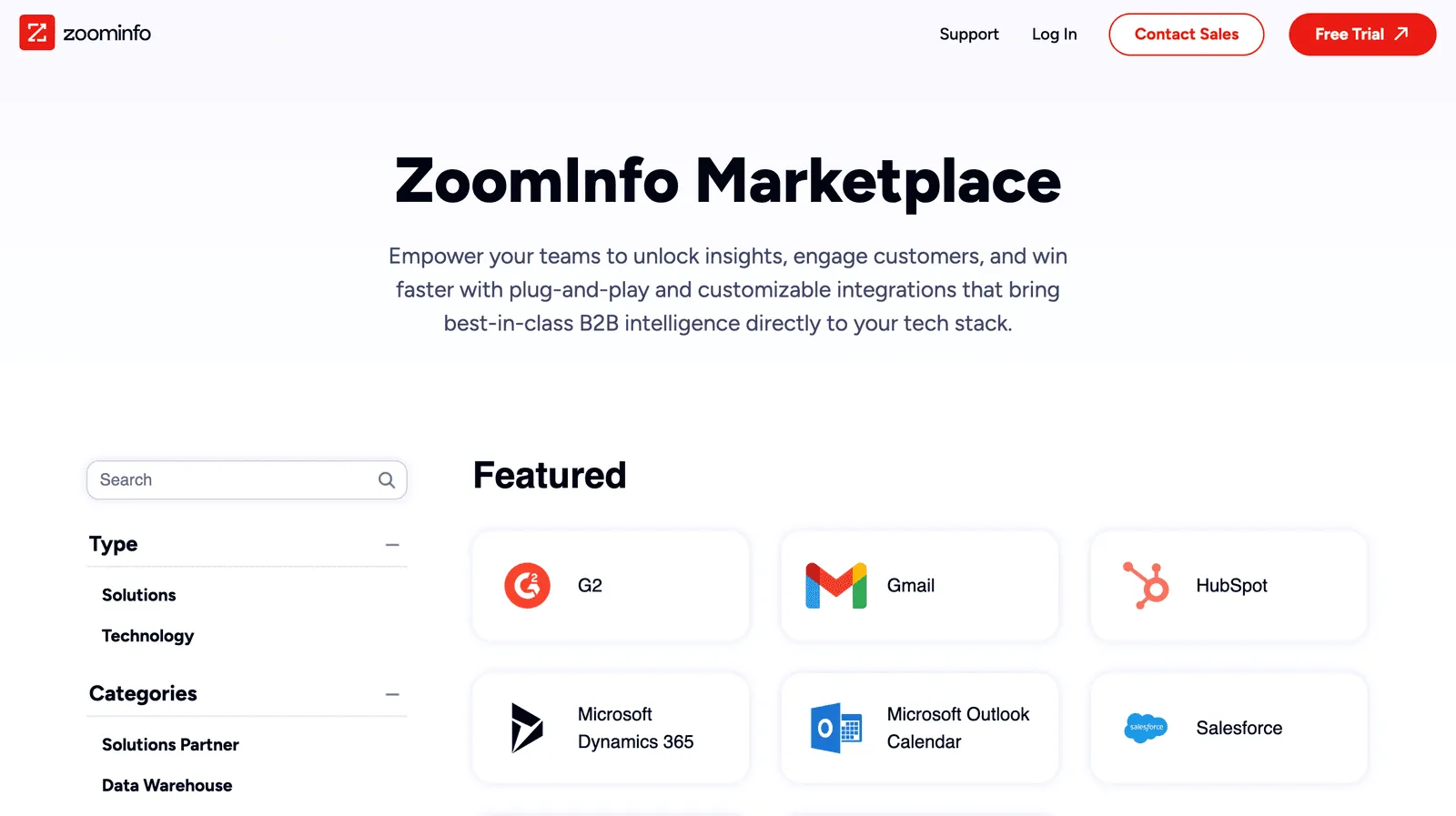
An app marketplace is a branded destination where customers discover, evaluate, and adopt integrations, apps, and partner solutions that extend your product. Depending on the company, it may instead be called an integration marketplace, partner marketplace, partner directory, or partner locator.
The label varies, but the purpose is the same: make your ecosystem usable and visible.
We see this across Partner Fleet customers like G2, ZoomInfo, Mindbody, and Healthie, where marketplaces help customers assemble complete solutions through integrations and trusted partners. For mid-market and enterprise SaaS, the logic is the same. The difference is execution.
Want to make your marketplace work better for customers?
Get our 40 page guide on how to build an app marketplace, including best practices on what to include, user workflows, and technology considerations.
Showcase AI Agents
Why your SaaS needs an app marketplace
A real marketplace does three things well.
It increases retention by embedding your product deeper into customer workflows. It expands functionality without bloating your roadmap. And it turns integrations into a visible growth lever for sales, marketing, and partnerships.
This is not about listing logos. It’s about making integrations discoverable, adoptable, and measurable.
Executives care about stickiness, expansion, and leverage. A marketplace delivers all three when it’s built correctly.
Who benefits from your marketplace
A marketplace only works if it serves multiple audiences at once.
Customers use it to solve real problems faster, without waiting on your roadmap. Clear categories, strong search, and use-case driven listings matter more than volume.
Partners use it as a distribution channel. Visibility, conversion-focused listings, and self-serve updates determine whether they invest or disengage.
Your internal teams use it as proof. Sales uses it to close. Product uses it for roadmap signal. Partnerships uses it to scale without manual work.
If any one of these groups is ignored, the marketplace stalls.
The build decision every team faces
Once the value is clear, most teams land on one of two paths.
Build it internally, or use a dedicated app marketplace builder.
Building in-house sounds appealing on paper. Full control, custom UX, internal ownership. In practice, it becomes a long-running project with no clear finish line.
Marketplaces require search, taxonomy, partner workflows, analytics, SEO, and constant iteration. Plus, it should be controlled by partnerships and product teams, not engineers. None of that is core product differentiation, but all of it demands ongoing engineering time.
An app marketplace builder exists for exactly this reason.
Thinking about launching a marketplace?
If you’re weighing build vs buy, start with a clear view of what a modern marketplace actually requires.
Get the calculator
Where your marketplace should live
Placement matters, and most teams get this wrong early.
A marketplace on your marketing site drives discovery and SEO. An embedded marketplace inside your product drives adoption. The strongest programs do both, using one system to power each experience.
Trying to maintain separate systems creates content drift and operational drag. One source of truth is non-negotiable if you want scale.
Why a CMS breaks down fast
Some teams try to assemble a marketplace using Webflow, WordPress, or another CMS. It works at ten listings. It breaks at fifty.
CMS tools are not designed for partner workflows, advanced filtering, or integration-specific analytics. Every workaround becomes custom code. Every feature request becomes technical debt.
What looks cheaper upfront usually costs more in maintenance, security risk, and missed opportunities.
The real advantage of an app marketplace builder
Speed matters, but it’s not the main advantage.
An app marketplace builder gives you purpose-built infrastructure for listings, taxonomies, partner portals, analytics, and branding without pulling engineers off your core roadmap.
You launch faster, iterate more often, and avoid rebuilding the same components every ecosystem team eventually needs.
More importantly, you get a marketplace designed to drive adoption and partner ROI, not just host content.
Why teams choose Partner Fleet
Partner Fleet is an app marketplace builder designed for B2B SaaS ecosystems.
It supports public and in-app marketplaces, partner directories, and developer portals from a single system. Teams use it to launch faster, reduce engineering overhead, and turn integrations into a visible growth channel.
You get structured taxonomies, conversion-focused listing pages, partner self-serve workflows, and analytics that actually support executive reporting.
If your marketplace is meant to scale, it needs infrastructure built for that job.
Book a demo and see what a real app marketplace builder looks like.
Keep reading
Browse all posts
How Phenom turned 200 idle partners into $500K+ in partner program revenue
How Phenom built a tiered partner program and earned $500k+ in partner program revenue in under one year.

Partner Fleet launches In-App Marketplace, bringing integration adoption inside the product
The new module gives companies a conversion-optimized integration experience for their customers, plus the analytics to prove what integrations are worth.

Partnerships in 2026: Retention is the real growth lever
Get it right early, and you'll have a great year.