Why the Salesloft Marketplace Is a Blueprint for Ecosystem Design
Deliberate in all the right ways.

At Partner Fleet, we spend a lot of time inside app marketplaces. We see what works, what doesn’t, and where good intentions fall apart in execution.
Every so often, though, we come across a marketplace that feels deliberate in all the right ways. The Salesloft marketplace is one of those.
Yes, we’re proud that the Salesloft team chose Partner Fleet to power their marketplace. But credit where it’s due. The clarity, restraint, and consistency here come from the Salesloft team themselves. Their marketplace reflects a strong point of view on how integrations should be discovered, understood, and adopted.
If you’re building an app marketplace, or evolving one beyond a basic integrations page, there’s a lot to learn from how Salesloft approaches it.
Let’s take a closer look.
Thoughtful design decisions that actually matter
The Salesloft marketplace makes a strong first impression, not because it’s flashy, but because it’s intentional.
Always highlighting a featured partner
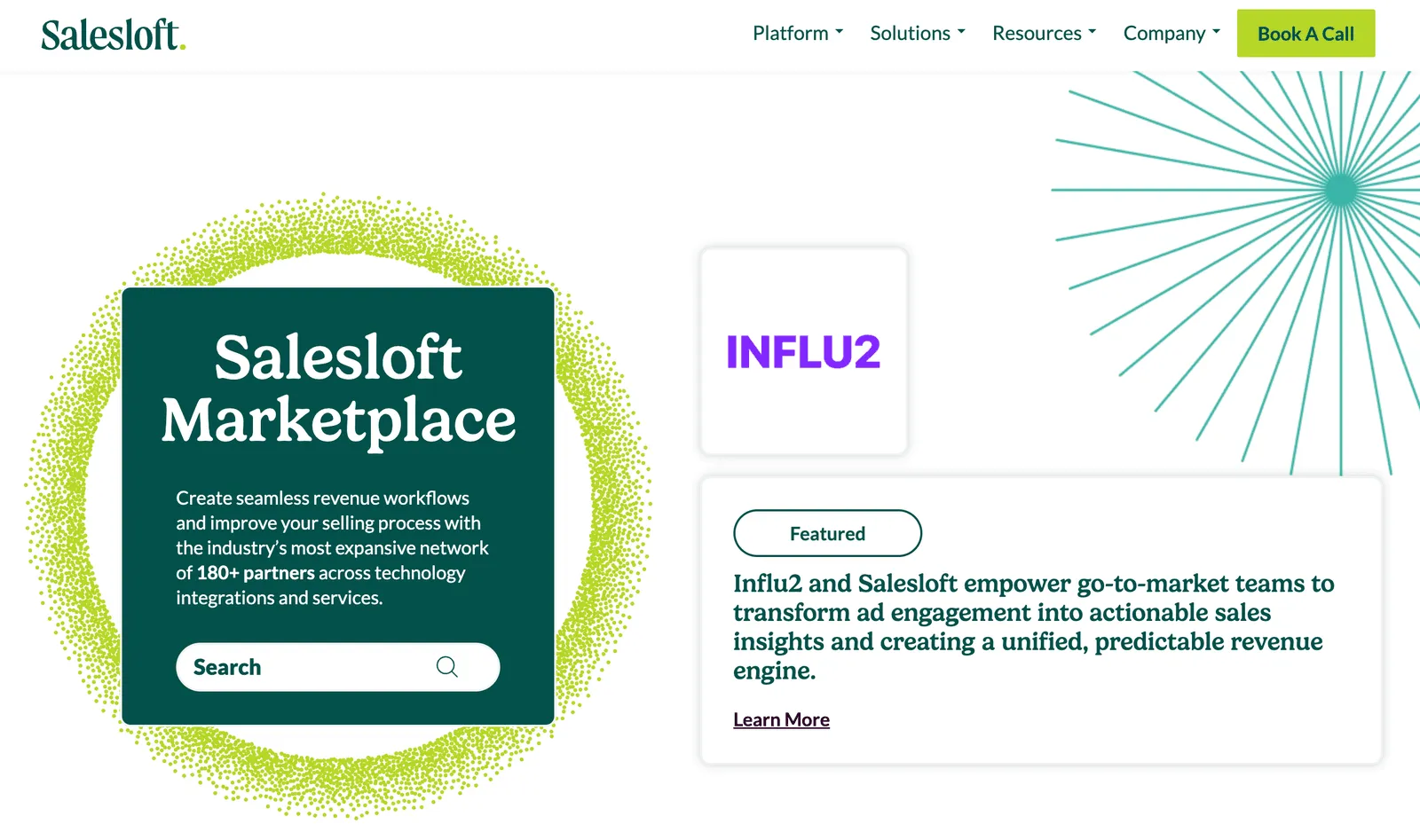
Front and center on the marketplace homepage is a featured partner, rotated monthly. This does more than spotlight an integration. It sends a clear signal to partners about where Salesloft is investing and what success looks like in the ecosystem.
It’s a simple mechanic, but an effective one. Featured placements create momentum for partners, drive focused discovery for users, and give the ecosystem a sense of motion without overwhelming the page.
A unified experience across Salesloft and Drift
Following the acquisition of Drift, Salesloft could have easily ended up with two separate integration hubs.
Instead, they made a more disciplined choice.
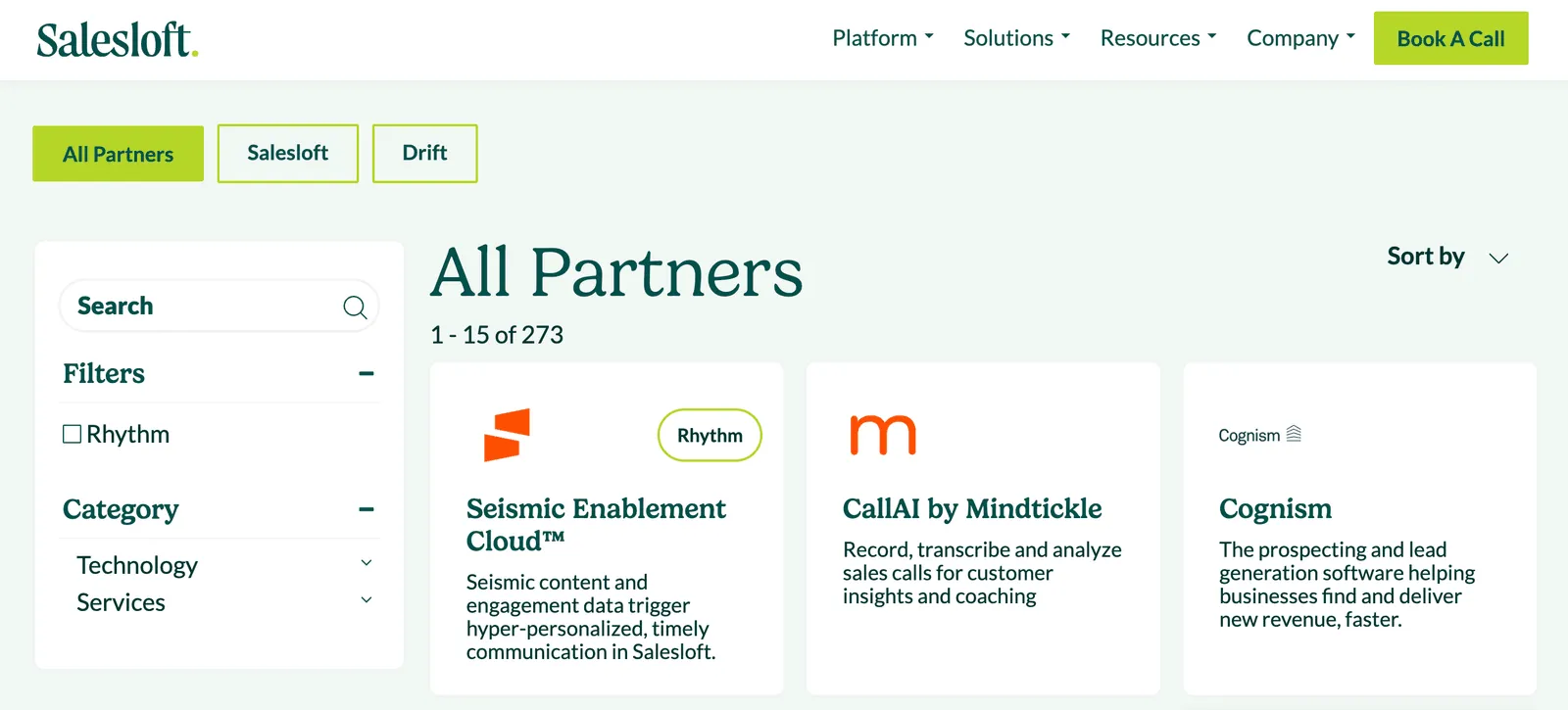
Both Salesloft and Drift integrations live within the same marketplace experience, clearly organized into distinct sections. The result is a unified ecosystem that reflects the combined value of both platforms, without creating confusion or fragmentation for users.
It’s a strong example of managing growth without sacrificing clarity.
Clear categories with one smart point of emphasis
The marketplace uses well-defined categories for both technology and service partners, making it easy to scan and narrow down options quickly.
What stands out is the single, prominent filter for Rhythm. Rather than overloading the experience with feature-based filters, Salesloft highlights one core capability that matters deeply to their users.
It’s a subtle move that reinforces product value while still keeping the marketplace easy to navigate.
Simple, consistent branding
The marketplace looks and feels like Salesloft. Clean, confident, and familiar.
There’s no overdesign here. The experience mirrors the core product closely enough that users trust what they’re seeing and understand where they are. That consistency goes a long way in making the marketplace feel like a natural extension of the platform, not a separate destination.
Listing pages built for real adoption
Discovery is only half the battle. The real work happens on the listing pages.
Salesloft clearly understands that.
Clear descriptions and setup guidance
Each integration listing explains not just what the integration is, but how it works and how to get started. Setup steps are easy to find and easy to follow, which removes friction at the moment when users are deciding whether to adopt.
That clarity pays off in faster activation and fewer support questions down the line.
Visuals that accelerate confidence
Listings include multiple screenshots and, in many cases, GIFs that show the integration in action. These visuals help users quickly understand what they’re getting and how it fits into their workflow.
Instead of guessing, users can see the value before committing.
Support content where users need it
FAQs, related services, and additional resources are embedded directly into the listing pages. This creates a self-serve experience that answers common questions without forcing users to leave the marketplace.
As a side effect, it also creates rich, indexable content that strengthens long-tail discovery across search and AI-driven channels.
Ready to design a marketplace like this?
Download our 40-page guide for building your app marketplace, including scopes & workflows.
Get the guide
Behind the scenes: supporting partners at scale
What users see publicly is only part of the story.
Salesloft has invested heavily in a partner portal that gives integration partners access to the resources they need to succeed, including product updates, enablement materials, and go-to-market guidance.
That investment shows ecosystem maturity. When partners are well-equipped, they can support customers more effectively, align with product direction, and drive better outcomes across the board.
What to take from Salesloft
The Salesloft marketplace works because it treats the ecosystem as product infrastructure, not supporting content.
If you want to emulate what they’ve built, a few fundamentals stand out:
Design with intent. Featured partners, clean structure, and focused filters guide discovery without overwhelming users.
Unify the ecosystem as you grow. Bringing Salesloft and Drift integrations into a single, well-organized experience reinforces clarity during expansion.
Make listings do the heavy lifting. Clear descriptions, setup guidance, and visuals reduce friction and accelerate adoption.
Reinforce trust through consistency. Familiar branding and thoughtful presentation make the marketplace feel like a natural extension of the product.
Support partners beyond the page. A strong partner portal signals long-term commitment and helps the ecosystem scale sustainably.
Salesloft didn’t build a marketplace to showcase logos. They built it to drive adoption, clarity, and real ecosystem value. That’s the standard worth aiming for.
Turn your ecosystem into a growth lever
Partner Fleet helps SaaS teams design marketplaces that drive discovery, adoption, and partner confidence, without overbuilding or overcomplicating.
Book a demo
Keep reading
Browse all posts
Partner Fleet launches In-App Marketplace, bringing integration adoption inside the product
The new module gives companies a conversion-optimized integration experience for their customers, plus the analytics to prove what integrations are worth.

Partnerships in 2026: Retention is the real growth lever
Get it right early, and you'll have a great year.

How Mindbody built the #1 integrations marketplace in fitness tech
A powerhouse company with a powerhouse marketplace.