
Top AI integrations shaping modern software platforms
A builder’s guide to how AI connects, scales, and compounds
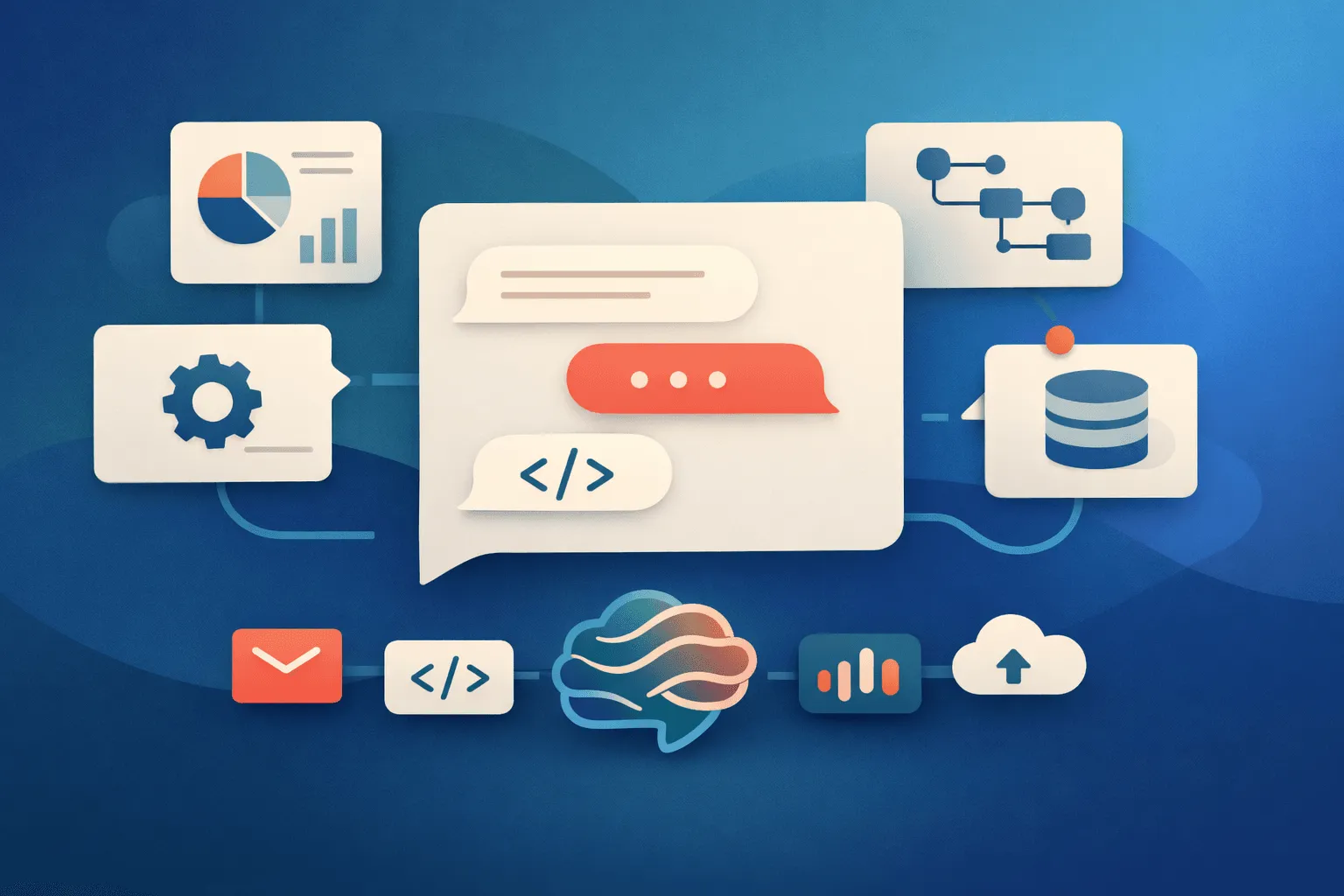
The AI conversation has matured.
What used to be about standalone tools is now about integration surfaces. AI is no longer something users “go to.” It’s something that shows up inside the tools they already rely on, embedded directly into workflows, data layers, and decision paths.
For teams building AI products or extending platforms like ChatGPT, Claude, Microsoft Copilot, Perplexity, and Gemini, the question isn’t “what can the model do?”
It’s what should the model connect to?
Below are the dominant categories of AI integrations being built today, and why they matter.
:root{
--pf-teal:#133c46;
--pf-blue:#2f5f98;
--pf-navy:#0b2530;
--pf-coral:#d77a61;
--pf-cream:#f6f3ee;
--pf-ink:#0f172a;
--pf-border:rgba(255,255,255,0.14);
}
.pf-taxonomy-wrap{
background: linear-gradient(90deg, var(--pf-teal) 0%, var(--pf-blue) 80%);
border-radius: 16px;
padding: 20px;
box-shadow: 0 10px 26px rgba(0,0,0,0.20);
margin: 28px 0;
}
.pf-taxonomy-head{
display:flex;
align-items:flex-start;
justify-content:space-between;
gap: 16px;
margin-bottom: 14px;
}
.pf-taxonomy-title{
color: #f6f3ee;
font-weight: 700;
font-size: 24px;
line-height: 1.2;
margin: 0;
letter-spacing: 0.2px;
}
.pf-taxonomy-sub{
color: rgba(246,243,238,0.82);
margin: 6px 0 0;
font-size: 14px;
line-height: 1.35;
max-width: 70ch;
}
.pf-pill{
display:inline-block;
background: rgba(215,122,97,0.14);
border: 1px solid rgba(215,122,97,0.35);
color: var(--pf-cream);
border-radius: 999px;
padding: 6px 10px;
font-size: 12px;
white-space: nowrap;
}
.pf-taxonomy{
width: 100%;
border-collapse: separate;
border-spacing: 0;
overflow: hidden;
border-radius: 12px;
background: rgba(255,255,255,0.08);
border: 1px solid rgba(255,255,255,0.16);
backdrop-filter: blur(6px);
}
.pf-taxonomy thead th{
text-align:left;
font-size: 12px;
letter-spacing: 0.4px;
text-transform: uppercase;
padding: 12px 12px;
background: rgba(11,37,48,0.85);
color: #f6f3ee;
border-bottom: 1px solid rgba(255,255,255,0.25);
line-height: 1.4;
}
.pf-taxonomy tbody td{
vertical-align: top;
color: rgba(246,243,238,0.92);
padding: 12px 12px;
border-bottom: 1px solid rgba(255,255,255,0.10);
font-size: 14px;
line-height: 1.35;
}
.pf-taxonomy tbody tr:nth-child(even){
background: rgba(255,255,255,0.04);
}
.pf-taxonomy tbody tr:last-child td{
border-bottom: none;
}
.pf-muted{
color: rgba(246,243,238,0.75);
font-size: 13px;
}
.pf-badges{
display:flex;
flex-wrap: wrap;
gap: 6px;
}
.pf-badge{
display:inline-block;
padding: 4px 8px;
border-radius: 999px;
font-size: 12px;
line-height: 1;
background: rgba(255,255,255,0.14);
border: 1px solid rgba(255,255,255,0.22);
color: #f6f3ee;
}
.pf-badge.coral{
background: rgba(215,122,97,0.28);
border-color: rgba(215,122,97,0.55);
}
.pf-badge.blue{
background: rgba(47,95,152,0.28);
border-color: rgba(47,95,152,0.55);
}
.pf-taxonomy-note{
margin-top: 12px;
color: rgba(246,243,238,0.78);
font-size: 13px;
line-height: 1.35;
}
@media (hover: hover){
.pf-taxonomy tbody tr:hover{
background: rgba(255,255,255,0.07);
}
}
/* Mobile */
@media (max-width: 720px){
.pf-taxonomy-wrap{ padding: 16px; }
.pf-taxonomy-head{ flex-direction: column; }
.pf-pill{ align-self:flex-start; }
.pf-taxonomy thead{ display:none; }
.pf-taxonomy, .pf-taxonomy tbody, .pf-taxonomy tr, .pf-taxonomy td{
display:block;
width:100%;
}
.pf-taxonomy tr{
border: 1px solid rgba(255,255,255,0.10);
border-radius: 12px;
overflow:hidden;
margin-bottom: 10px;
background: rgba(11,37,48,0.35);
}
.pf-taxonomy td{
border-bottom: 1px solid rgba(255,255,255,0.10);
}
.pf-taxonomy td:last-child{ border-bottom:none; }
.pf-taxonomy td[data-label]::before{
content: attr(data-label);
display:block;
font-size: 11px;
letter-spacing: 0.35px;
text-transform: uppercase;
color: rgba(246,243,238,0.72);
margin-bottom: 6px;
}
}
AI integration taxonomy (what’s getting built)
A builder-friendly map of the dominant integration types, where they live in the stack, and why they exist.
Use this as your roadmap
| Integration type | Where it shows up | What it enables | Common connectors | Why it matters |
|---|---|---|---|---|
| productivity + knowledge work copilots inside docs, email, meetings | workspace suites, comms, docs | summaries, drafting, Q&A over content, meeting takeaways | docs email calendar meetings | adoption scales because it sits where work already happens |
| gtm + customer crm, support, marketing, cs | crm, ticketing, marketing ops | personalization, forecasting, next-best actions, agent assist | crm support email ads | turns systems of record into systems of action |
| workflow + agent orchestration multi-step, tool-using AI | automation platforms, internal tools | trigger → reason → act, approvals, handoffs, retries, SLAs | webhooks slack jira zendesk zapier | this is where assistants become operators |
| developer tools ide + repo intelligence | ides, ci, code review | code completion, test gen, refactors, docs, PR summaries | github gitlab vscode jetbrains | dev experience becomes a first-class AI surface |
| data + analytics nlq, insights, forecasting | bi tools, warehouses, notebooks | ask questions in plain english, explain anomalies, generate reports | snowflake bigquery dbt power bi | analytics becomes accessible without dumbing it down |
| search + retrieval (rag) knowledge over live + internal sources | research, support, internal Q&A | grounded answers, citations, doc Q&A, internal discovery | confluence google drive notion sharepoint vector db | retrieval is often the real product, not generation |
| creative + media design, video, audio | creative suites, content ops | asset generation, repurposing, editing by intent | adobe canva descript dam | production scales without scaling headcount |
| security + governance trust layers for enterprise rollout | identity, audit, data controls | permissions, policy enforcement, logging, safe tool access | okta entra siem dlp | without guardrails, AI stalls at pilots |
Tip: if you’re building an integration ecosystem, treat this taxonomy like your marketplace categories.
Clear buckets reduce confusion, speed discovery, and make partner contributions easier to scale.
Think beyond individual integrations
AI value compounds when it’s connected across your ecosystem. Understanding integration patterns is the first step to building something durable.
Get the report
1. Productivity and knowledge-work integrations
This is where AI adoption went mainstream.
AI platforms are deeply integrated into the tools people already use to write, communicate, and organize work. These integrations reduce context switching and turn natural language into a control layer for software.
- Microsoft Copilot spans Word, Excel, PowerPoint, Outlook, and Teams, acting as a shared intelligence layer across documents, data, and conversations.
- Gemini for Workspace brings similar capabilities to Docs, Sheets, Gmail, and Meet, embedding generative and summarization workflows directly into collaboration.
- ChatGPT now integrates with document uploads, browsing, custom GPTs, and internal knowledge bases, making it a flexible front end for knowledge work.
These integrations succeed because they don’t ask users to learn a new tool. They extend the ones they already trust.
2. Customer, revenue, and go-to-market integrations
AI is now expected inside revenue systems, not bolted on later.
CRM, support, and marketing platforms are integrating AI to assist with forecasting, personalization, and customer communication at scale.
- Salesforce Einstein Copilot layers AI across Sales, Service, and Marketing Clouds, with a strong focus on trust, permissions, and data boundaries.
- HubSpot AI embeds generation, personalization, and analysis directly into CRM workflows.
- Zendesk AI integrates into support tooling to summarize tickets, suggest responses, and automate first-line resolution.
The pattern here is clear. AI doesn’t replace systems of record. It activates them.
3. Workflow automation and agent orchestration
This is one of the fastest-growing integration categories.
Instead of single prompts, teams are building multi-step AI workflows that connect models to triggers, tools, and downstream actions.
- Platforms like Zapier, Make, and n8n are integrating AI steps directly into automation flows.
- AI agents are being wired into ticketing systems, internal tools, CRMs, and data warehouses.
- Chat-based interfaces become control planes for executing real work, not just generating text.
This category matters because it’s where AI shifts from assistant to operator.
4. Developer tooling and code intelligence
AI integration is fundamentally reshaping how software gets built.
- GitHub Copilot integrates directly into IDEs like VS Code and JetBrains, providing real-time code suggestions and completions.
- Tools like Tabnine and similar assistants embed into developer workflows to reduce boilerplate and accelerate delivery.
- Claude and ChatGPT are increasingly used as API-aware coding partners, documentation assistants, and test generators.
For builders, this reinforces a key truth. Developer experience is now an AI surface.
5. Data, analytics, and decision support
AI is becoming the interface for asking questions of data.
Instead of dashboards alone, platforms are integrating natural-language querying, forecasting, and explanation directly into analytics tools.
- Tableau GPT and Microsoft Power BI allow users to query data conversationally.
- AI models surface trends, anomalies, and insights without requiring SQL fluency.
- These integrations democratize analytics without removing rigor.
This category is about speed to insight, not just visualization.
6. Search, research, and knowledge retrieval
This is where platforms like Perplexity stand out.
AI is increasingly integrated with live search, citations, and retrieval-augmented generation (RAG), blending LLMs with real-time or proprietary data sources.
- Perplexity combines search, synthesis, and sourcing into a single experience.
- Enterprise teams are integrating AI with internal wikis, document stores, and knowledge bases.
- This pattern shows up heavily in ChatGPT and Claude deployments for internal research.
For many organizations, retrieval is the real product, not generation.
7. Creative, media, and content production
Beyond text, AI integrations are accelerating visual, audio, and video workflows.
- Adobe Sensei GenAI integrates across Creative Cloud and Experience Cloud for asset generation and personalization.
- Canva Magic Studio embeds AI into design workflows, lowering the barrier to professional-grade output.
- Descript integrates AI into audio and video editing, turning transcripts into the editing surface.
These tools succeed because they integrate where creation already happens.
8. Operations, security, and governance integrations
Often overlooked, but critical for enterprise adoption.
AI platforms are being integrated with:
- Identity and access management
- Data classification and permissions
- Audit logging and compliance workflows
This is where Gemini, Copilot, and Salesforce have leaned heavily into trust layers and governance models. Without this category, AI stalls at experimentation.
What this means for builders and platform teams
The best AI platforms aren’t winning because they have “AI features.” They’re winning because they’re becoming extensible surfaces. The model is only one piece. The real leverage comes from what the model can safely touch, what it can trigger, and how easily other teams can build on top of it.
If you’re evaluating or building AI integrations, focus less on demos and more on the platform mechanics:
- where AI sits in the workflow
- what data it can access, and under what permissions
- how tool use is governed and audited
- how partners extend the experience without creating maintenance debt
AI is turning software into platforms again. The teams that treat integrations as a product surface, not a backlog, will compound faster.
Build an AI-ready integration ecosystem
As AI platforms become more extensible, a unified approach to integrations, partners, and developer experience matters.
Book a demo
Keep reading
Browse all posts
Partner Fleet launches In-App Marketplace, bringing integration adoption inside the product
The new module gives companies a conversion-optimized integration experience for their customers, plus the analytics to prove what integrations are worth.

Partnerships in 2026: Retention is the real growth lever
Get it right early, and you'll have a great year.
How Mindbody built the #1 integrations marketplace in fitness tech
A powerhouse company with a powerhouse marketplace.