
The quiet trust test in legal tech: your integrations marketplace
Lawyers do not evaluate software the same way most SaaS buyers do.

Lawyers do not evaluate software the same way most SaaS buyers do.
They are trained to read closely, question assumptions, and look for risk in the fine print. Whether the buyer is a solo attorney, a small firm partner, or an operations or IT lead inside a larger firm, the evaluation mindset is the same.
Does this tool respect the seriousness of our work?
That is why, in legal tech, the integrations marketplace quietly becomes a trust test. Not because integrations themselves are novel, but because how you present them reveals how seriously you take security, accuracy, and professional standards.
Legal buyers look for rigor, not reassurance
For many legal tech categories, the buyer is often a practicing lawyer. In others, it may be an office manager, operations leader, or IT administrator acting on behalf of the firm.
Different roles, same concerns.
They are all evaluating:
- Data security and client confidentiality
- Operational risk
- Time saved versus time lost
- Whether this platform will hold up under scrutiny
They are not swayed by light marketing language or surface-level claims. They look for evidence of rigor.
Your integrations marketplace is one of the first places they find it, or don’t.
How SaaS teams are actually approaching integrations in 2026
Data from B2B SaaS companies on integration strategy, security expectations, and ecosystem maturity, including insights relevant to regulated industries like legal tech.
Get the report
What legal buyers actually assess when they view your marketplace
Lawyers and firm administrators do not open an integrations marketplace to browse casually. They read it the way they read contracts, policies, and compliance documentation.
They are asking questions like:
Is this vendor serious about security?
SOC2 Type II compliance, clear data handling explanations, and explicit ownership of integrations signal maturity. The absence of this information creates doubt immediately.
Is this built for professionals?
Legal buyers are used to reading long, detailed documents. A thin listing with vague descriptions feels careless, not streamlined. Clear language, depth, and precision build confidence.
Will this save real time, or create more work?
Legal professionals have extremely valuable time. They care less about flashy integrations and more about whether data can move automatically between tools without manual effort, duplicate entry, or risk of error.
For firms with IT or operations staff, this evaluation becomes even sharper. They are responsible for protecting the firm from downstream issues, not just choosing a convenient tool.
Why presentation matters more in legal tech than most industries
In many SaaS categories, simplicity wins. In legal tech, clarity and completeness win.
A well-designed integrations marketplace for legal professionals:
- Looks professional and intentional
- Uses precise, legal-adjacent language
- Explains exactly what data moves, where, and why
- Makes security posture easy to evaluate
- Reflects a respect for how law firms operate
Lawyers are not intimidated by detail. They are suspicious of its absence.
Efficiency is not a nice-to-have, it is the value
Time is the most constrained resource in a law firm.
Whether it is a solo attorney or a firm with dedicated staff, the expectation is the same. Software should reduce manual work, not create more of it.
The most valuable integrations marketplaces make it clear how:
- Client intake data flows into practice management systems
- Matter details sync across tools without re-entry
- Billing, documents, and case information stay aligned
- Leads and client updates move automatically between systems
This is not about convenience. It is about protecting billable time and reducing human error.
Legal buyers pay close attention to whether a platform understands this reality.
What leading legal platforms signal through their ecosystems
You can see this mindset reflected across established legal tech platforms like Smokeball, Clio, and Relativity.
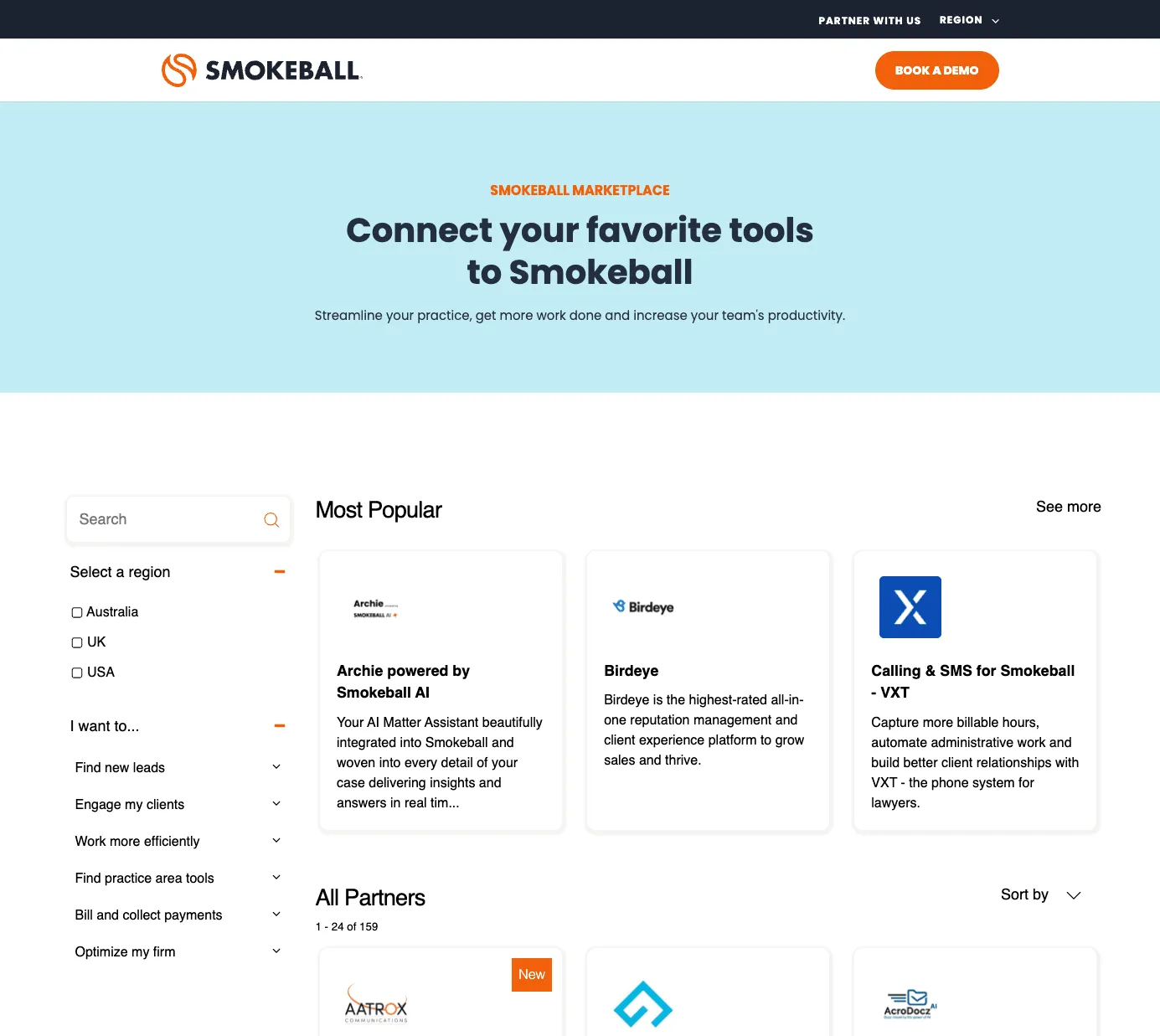
Different audiences, different use cases, same underlying expectation. Their ecosystems are presented with structure, depth, and seriousness because that is what legal buyers expect from tools they trust with client data.
The integrations marketplace becomes less about discovery and more about validation.
A shrewd, busy buyer notices more than you think
Lawyers are intelligent, skeptical, and time-poor buyers.
They may never say it explicitly, but they notice:
- Sloppy language
- Missing security signals
- Thin explanations
- Unclear ownership
- Overly generic positioning
All of that feeds into a quiet judgment call.
If this is how the vendor presents their integrations, how careful are they everywhere else?
The bottom line
In legal tech, trust is not built through bold claims.
It is built through evidence of care.
The way you set up your integrations marketplace signals how seriously you take security, professionalism, and efficiency. For lawyers and law firm buyers, that signal matters more than most teams realize.
A thoughtful, compliant, detailed marketplace does more than showcase integrations. It reassures a cautious, capable buyer that your platform belongs in their firm.
And that reassurance is often what closes the gap between interest and adoption.
See what a compliant integrations marketplace looks like
Explore how Partner Fleet helps legal tech platforms build secure, professional integrations marketplaces designed for cautious, time-constrained buyers.
Book a demo
Keep reading
Browse all posts
How Phenom turned 200 idle partners into $500K+ in partner program revenue
How Phenom built a tiered partner program and earned $500k+ in partner program revenue in under one year.

Partner Fleet launches In-App Marketplace, bringing integration adoption inside the product
The new module gives companies a conversion-optimized integration experience for their customers, plus the analytics to prove what integrations are worth.

Partnerships in 2026: Retention is the real growth lever
Get it right early, and you'll have a great year.