
The new HR tech trust signal: a visible partner marketplace
“We integrate with everything” is table stakes, and often a red flag.

HR tech buyers do not trust integration claims anymore.
“We integrate with everything” is table stakes, and often a red flag.
What buyers actually trust is proof. A visible, built-in partner marketplace that shows exactly how a platform fits into their stack before they ever talk to sales.
That shift matters, because HR tech buying is high-stakes by default.
Payroll, compliance, benefits, recruiting, employee data. When something breaks, it is not an inconvenience. It is a business risk. And buyers behave accordingly.
Trust is the real buying criteria in HR tech
HR leaders are not just evaluating features. They are evaluating risk.
They want to know:
- Will this work with the systems we already rely on?
- How painful will implementation be?
- Is this vendor built to last?
In crowded HR categories, trust is often the deciding factor. And increasingly, buyers assess that trust by looking at your ecosystem, not your sales deck.
A partner marketplace has become one of the fastest ways buyers answer the question, “Can I trust this platform?”
A visible partner marketplace signals platform maturity
Modern HR platforms do not pretend they operate in isolation.
They acknowledge reality. HR teams run on ecosystems. Payroll connects to benefits. Recruiting connects to onboarding. Compliance connects to finance.
A strong partner marketplace signals:
- We understand real-world HR workflows
- We have invested beyond APIs
- We support how customers actually operate
This is why leading HR tech companies no longer treat integrations as a footnote. They make them visible, structured, and easy to explore.
What HR buyers infer when they explore your marketplace
When buyers open your partner marketplace, they are not browsing casually. They are answering three critical questions.
Does this fit our stack?
Buyers look for familiar tools and common patterns. Seeing relevant partners immediately reduces uncertainty and helps buyers self-qualify faster.
How risky will implementation be?
Clear listings, defined scopes, and documented ownership lower perceived risk. Vague integration promises do the opposite.
A visible partner marketplace makes adoption feel achievable instead of intimidating.
Is this company built for the long term?
A maintained marketplace with active partners signals commitment. Buyers read this as operational maturity and long-term viability, not a short-term feature push.
Why “we integrate with everything” hurts credibility
HR buyers have heard it too many times.
When vendors say they “integrate with everything,” buyers translate that as:
- There is an API, but no product experience
- Integration work will fall on their team
- Costs and timelines are unclear
A partner marketplace replaces ambiguity with evidence.
It shows what exists today, how it works, and who owns it. That transparency builds confidence. The absence of it creates doubt.
Does your partner marketplace build trust?
HR tech buyers run a quiet checklist when they evaluate integrations. Most vendors fail it without realizing.
Use this quick self-assessment to see how your partner marketplace looks through a buyer’s eyes.
The HR tech partner marketplace trust checklist
Check all that apply:
Completeness score
0%
0/0 checked
0–40% risk
41–85% mixed signals
86–100% trust ready
Want to close the gaps?
Partner Fleet helps you ship a marketplace that looks credible to buyers and usable to customers.
Get a demo
/* Container */
#pf-trust-calc {
font-family: Inter, system-ui, -apple-system, Segoe UI, Roboto, Arial, sans-serif;
color: #0f172a;
max-width: 100%;
margin: 16px auto;
border: 1px solid #e5e7eb;
border-radius: 14px;
background: #fff;
overflow: hidden;
}
/* Header */
.pf-calc-header {
padding: 18px 20px 8px;
background: linear-gradient(
90deg,
rgba(19, 60, 70, 0.06) 0%,
rgba(47, 95, 152, 0.06) 80%
);
border-bottom: 1px solid #eef2f7;
}
.pf-calc-header h2 {
margin: 0 0 8px;
font-size: 20px;
letter-spacing: -0.01em;
}
.pf-calc-header p {
margin: 0 0 8px;
font-size: 13px;
color: #334155;
line-height: 1.45;
}
/* Layout */
.pf-calc-grid {
display: grid;
grid-template-columns: 1fr 320px;
}
@media (max-width: 900px) {
.pf-calc-grid {
grid-template-columns: 1fr;
}
.pf-calc-right {
border-left: none;
border-top: 1px solid #eef2f7;
}
}
.pf-calc-left,
.pf-calc-right {
padding: 18px;
}
.pf-calc-left h3 {
margin: 0 0 4px;
font-size: 16px;
}
.pf-subhead {
margin-bottom: 12px;
font-size: 13px;
color: #475569;
}
/* Checklist */
.pf-checklist {
display: flex;
flex-direction: column;
gap: 10px;
max-height: 360px;
overflow-y: auto;
padding-right: 4px;
}
.pf-item {
display: flex;
gap: 12px;
align-items: flex-start;
padding: 10px;
border: 1px solid #e5e7eb;
border-radius: 10px;
cursor: pointer;
background: #fff;
transition: background 0.15s ease, border-color 0.15s ease;
}
.pf-item:hover {
background: #f8fafc;
border-color: #cbd5e1;
}
.pf-item input {
width: 18px;
height: 18px;
accent-color: #2f5f98;
margin-top: 2px;
}
.pf-item-text {
font-size: 13px;
line-height: 1.35;
font-weight: 500;
}
/* Scrollbar */
.pf-checklist::-webkit-scrollbar {
width: 6px;
}
.pf-checklist::-webkit-scrollbar-thumb {
background: #cbd5e1;
border-radius: 6px;
}
/* Message */
.pf-message {
margin-top: 12px;
padding: 10px;
border-radius: 10px;
background: #f8fafc;
border: 1px dashed #cbd5e1;
font-size: 13px;
color: #334155;
line-height: 1.4;
}
/* Summary */
.pf-summary-card {
border: 1px solid #e5e7eb;
border-radius: 12px;
padding: 16px;
background: #fff;
}
.pf-summary-card h4 {
margin: 0 0 10px;
font-size: 12px;
text-transform: uppercase;
letter-spacing: 0.08em;
color: #64748b;
}
.pf-score {
display: flex;
justify-content: space-between;
align-items: baseline;
margin-bottom: 10px;
}
#pf-score-num {
font-size: 26px;
font-weight: 800;
}
.pf-score-meta {
font-size: 12px;
color: #64748b;
}
.pf-progress {
height: 12px;
background: #e5e7eb;
border-radius: 999px;
overflow: hidden;
margin-bottom: 10px;
}
.pf-bar {
height: 100%;
width: 0%;
background: #ef4444;
transition: width 0.25s ease, background-color 0.25s ease;
}
.pf-legend {
display: flex;
gap: 12px;
font-size: 12px;
color: #64748b;
margin-bottom: 14px;
}
.pf-dot {
display: inline-block;
width: 10px;
height: 10px;
border-radius: 999px;
margin-right: 6px;
}
.pf-dot.red { background: #ef4444; }
.pf-dot.yellow { background: #f59e0b; }
.pf-dot.green { background: #22c55e; }
/* CTA */
.pf-cta {
border-top: 1px solid #eef2f7;
padding-top: 12px;
}
.pf-cta-title {
font-weight: 700;
font-size: 13px;
margin-bottom: 4px;
}
.pf-cta-sub {
font-size: 13px;
color: #475569;
margin-bottom: 10px;
line-height: 1.4;
}
.pf-cta-btn {
display: inline-block;
padding: 10px 14px;
background: #2f5f98;
color: #fff;
border-radius: 10px;
text-decoration: none;
font-weight: 700;
font-size: 13px;
}
.pf-cta-btn:hover {
filter: brightness(0.96);
}
(function () {
const items = [
"Buyers can see integrations without talking to sales",
"Integrations are grouped by real HR use cases, not just logos",
"Each partner listing explains what problem it solves",
"Ownership and support expectations are clear",
"Setup and activation steps are visible",
"Integrations appear both publicly and in-product",
"The marketplace is actively maintained, not static",
"Partners are presented as part of the product, not an add-on"
];
const checklist = document.getElementById("pf-checklist");
const scoreNum = document.getElementById("pf-score-num");
const bar = document.getElementById("pf-bar");
const checkedEl = document.getElementById("pf-checked");
const totalEl = document.getElementById("pf-total");
const messageEl = document.getElementById("pf-message");
const intro = document.getElementById("pf-intro");
let introCollapsed = false;
totalEl.textContent = items.length;
function barColor(pct) {
if (pct <= 40) return "#ef4444";
if (pct <= 85) return "#f59e0b";
return "#22c55e";
}
function message(missed) {
if (missed >= 3) return "If you missed more than two, buyers probably see risk where you see capability.";
if (missed === 2) return "You’re close. Tighten up two gaps and the marketplace feels safer to buyers.";
if (missed === 1) return "Strong. One gap left that could still create friction in a buyer review.";
return "This is what trust looks like. Now focus on adoption, not explanation.";
}
function collapseIntro() {
if (introCollapsed) return;
intro.style.display = "none";
introCollapsed = true;
}
function update() {
const checked = checklist.querySelectorAll("input:checked").length;
const total = items.length;
const pct = Math.round((checked / total) * 100);
const missed = total - checked;
checkedEl.textContent = checked;
scoreNum.textContent = pct + "%";
bar.style.width = pct + "%";
bar.style.backgroundColor = barColor(pct);
messageEl.textContent = message(missed);
}
items.forEach((text, i) => {
const label = document.createElement("label");
label.className = "pf-item";
label.innerHTML = `
<input type="checkbox">
<div class="pf-item-text">${text}</div>
`;
label.querySelector("input").addEventListener("change", () => {
collapseIntro();
update();
});
checklist.appendChild(label);
});
update();
})();
Get the full marketplace checklist
A full RFP to help you understand where you are, and how to choose a vendor.
Download the checklist
How leading HR tech companies use partner marketplaces to build trust
You can see this trust-first approach clearly across modern HR platforms.
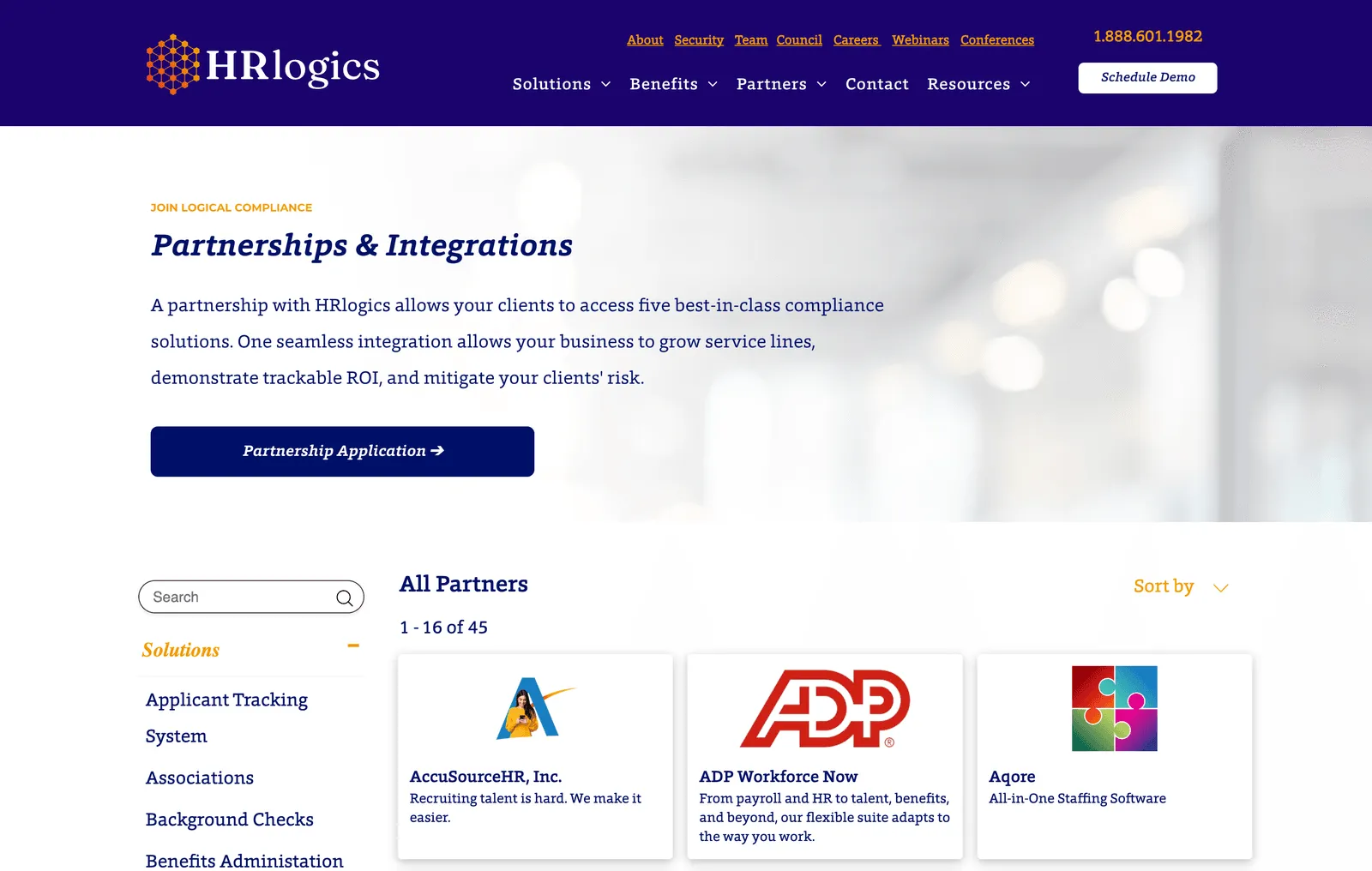
HR Logics operates in a compliance-heavy category where risk tolerance is low. The HR Logics partner marketplace helps buyers understand how HR Logics fits alongside payroll, benefits, and HRIS systems without relying on assumptions or sales explanations.
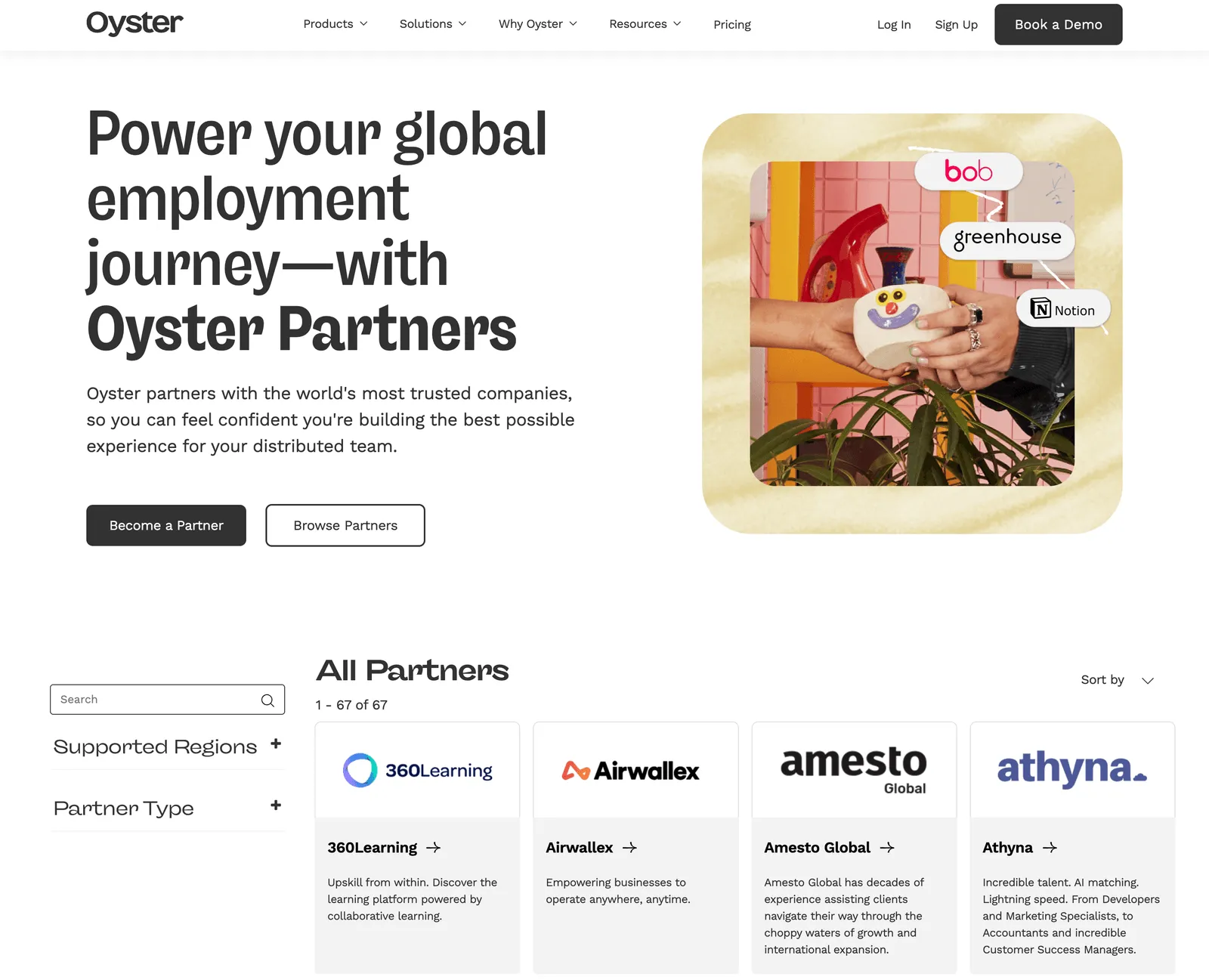
Oyster supports global employment, one of the most complex HR use cases. The Oyster partner marketplace helps buyers quickly see how Oyster connects to payroll, finance, and people tools across regions, reducing perceived risk early in the evaluation process.
SmartRecruiters treats its marketplace as an extension of the product. Recruiting teams can explore integrations by workflow and use case, making it easier to understand how the platform adapts to different hiring environments.
Different products, same pattern.
The marketplace answers buyer questions before they are asked.
Visibility drives adoption, not just trust
There is a second payoff many teams underestimate.
People do not use what they cannot find.
When integrations live in a visible partner marketplace:
- Buyers understand value faster
- Customers activate integrations sooner
- Time-to-value shrinks
This effect compounds when the marketplace exists both publicly and in-product. Buyers evaluate it pre-sale. Customers rely on it post-sale. The story stays consistent.
What HR tech buyers expect now
A logo wall is no longer enough.
Modern HR buyers expect:
- A dedicated partner marketplace, not a static page
- Clear use cases tied to real workflows
- Context about partners and why they matter
This is no longer advanced. It is baseline for modern HR platforms.
The bottom line
For today’s HR tech buyer, a visible partner marketplace is not just enablement.
It is a trust signal.
It reduces risk, clarifies stack fit, and accelerates adoption. It turns “we integrate” into something buyers can actually evaluate.
If integrations matter to your customers, they should be visible, structured, and part of the product experience, not buried behind a sales conversation.
Build buyer trust faster
See how leading HR tech platforms use a visible partner marketplace to reduce risk and drive adoption.
Book a demo
Keep reading
Browse all posts
How Phenom turned 200 idle partners into $500K+ in partner program revenue
How Phenom built a tiered partner program and earned $500k+ in partner program revenue in under one year.

Partner Fleet launches In-App Marketplace, bringing integration adoption inside the product
The new module gives companies a conversion-optimized integration experience for their customers, plus the analytics to prove what integrations are worth.

Partnerships in 2026: Retention is the real growth lever
Get it right early, and you'll have a great year.