
ServiceNow Integration Hub: a lesson in how great integration experiences should work
Demystifying the ServiceNow Integration Hub
Most integration experiences are held together with duct tape, prayer, and a Confluence page someone last updated in 2021. Then there’s ServiceNow Integration Hub, which feels like the rare example of a company treating integrations as a first-class product, not a side quest.
If you lead product or tech partnerships, it’s worth studying. Not because you’re trying to rebuild ServiceNow inside your own platform, but because the Hub nails a few fundamentals every SaaS company needs to get right to scale an integration ecosystem.
Here’s what ServiceNow does exceptionally well, why customers love it, and what you can borrow when designing your own integration strategy.
1. It treats integrations as a product, not plumbing
Most companies see integrations as “features that help close deals.” ServiceNow sees them as a core workflow engine. Integration Hub is positioned as infrastructure, not a nice-to-have, which shifts how teams think about automation, scale, and partner value.
Takeaway: If integrations feel like scattered side projects, you’ll always be playing catch-up. Treat them like a product line with a roadmap, documentation, quality standards, and ownership.
2. The low-code experience actually delivers
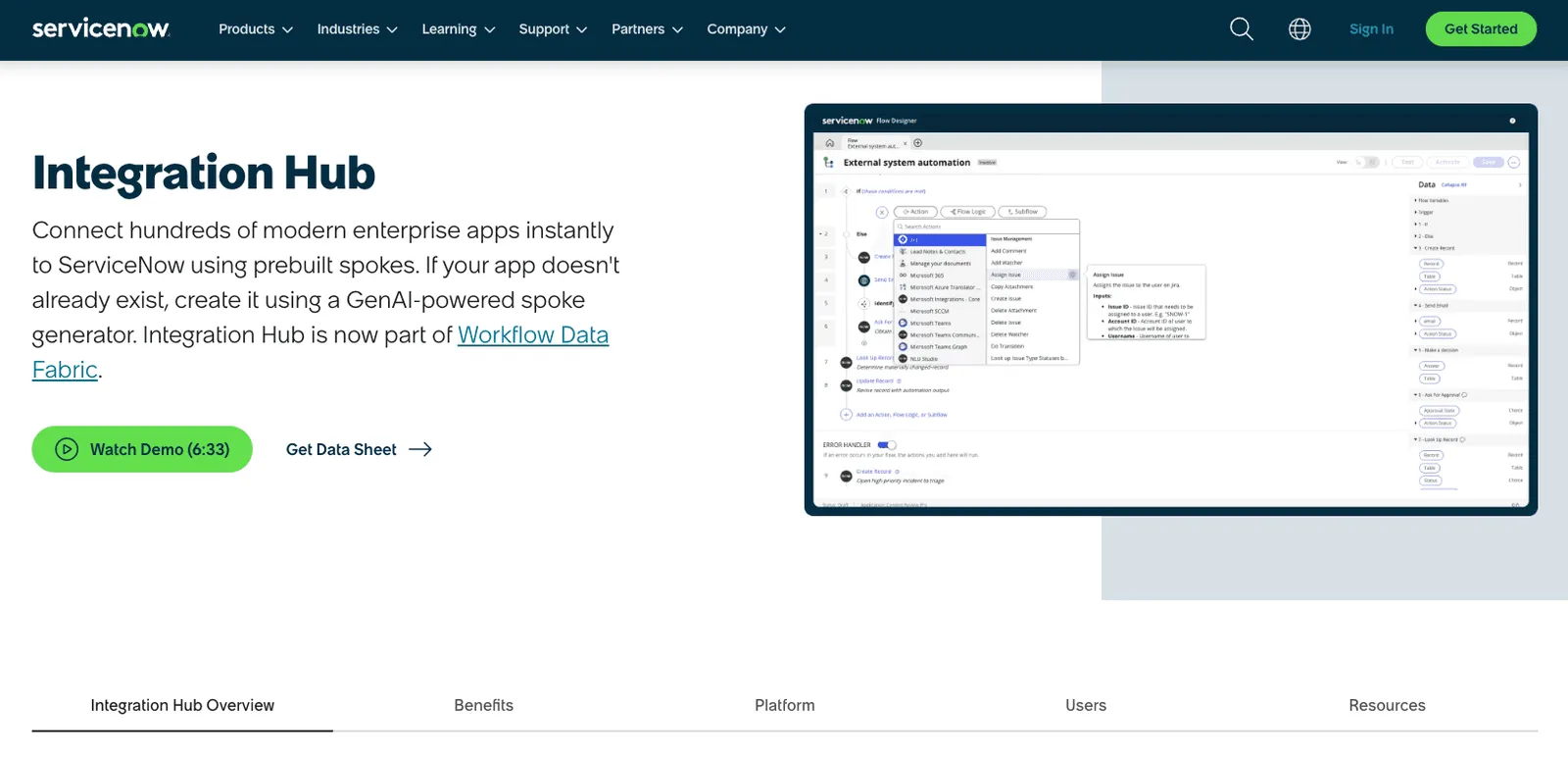
Flow Designer is simple, visual, and forgiving. You don’t need to be an engineer to automate multi-step workflows that touch multiple systems. That’s the unlock: people closer to the business logic can build and maintain what used to require deep technical help.
Takeaway: Customers shouldn’t need a developer to get value from your integrations. Reduce friction. Make configuration intuitive. Offer clear guidance. The less effort required, the higher the adoption.
3. Pre-built spokes accelerate time-to-value
ServiceNow understands that customers want immediate answers, not DIY projects. Their library of pre-built spokes gives teams a head start. The message is clear: “You’re 90 percent of the way there.”
Takeaway: Give your customers shortcuts. Pre-built templates, one-click configuration, examples, and starter workflows dramatically increase activation rates for your integrations.
4. Custom spokes keep the ecosystem flexible
ServiceNow knows not every system will have an out-of-the-box solution. Their custom spoke framework keeps the ecosystem extensible without forcing brittle workarounds or one-off engineering tickets.
Takeaway: Your platform doesn’t need infinite integrations, but it does need a scalable way for partners and customers to create what’s missing. This is how ecosystems grow without burning your engineering team out.
5. Monitoring and error handling make integrations reliable
This is where most SaaS companies fall short. Integrations break. APIs change. Payloads shift. ServiceNow gives teams visibility and guardrails so problems get caught early, not after someone’s quarterly report goes sideways.
Takeaway: Reliability is the difference between a fun integration and a critical one. Invest early in logs, health checks, and self-service tooling.
So why does this matter for your product?
Because your customers expect the same level of polish and clarity from your integration ecosystem.
They want:
- a single place to find your integrations
- clear explanations of what each integration does
- fast configuration
- confidence everything will keep running
That’s why companies like Zoom, HubSpot, and ServiceNow all built integration hubs that sit front and center in their product experience.
And it’s exactly why mid-market and enterprise SaaS companies use Partner Fleet.
Build your own integration hub (without reinventing the ServiceNow playbook)
Partner Fleet gives you the infrastructure to deliver your own Integration Hub experience:
- A branded, public marketplace for all your integrations
- An in-app marketplace that pulls from the same listings
- A developer portal where partners can build, test, and submit integrations
- Tools to scale your ecosystem without engineering fatigue
- Clear paths to activation that increase adoption and retention
You get the same fundamentals ServiceNow nails, but tailored to your ecosystem and your customers.
A great integration strategy isn’t about having dozens of connectors. It’s about creating a clean, obvious, reliable experience your customers trust.
ServiceNow set the standard. Now it’s your turn to build your own version of excellence.
Ready to design an Integration Hub your customers actually love?
Let's talk
Keep reading
Browse all posts
Partner Fleet launches In-App Marketplace, bringing integration adoption inside the product
The new module gives companies a conversion-optimized integration experience for their customers, plus the analytics to prove what integrations are worth.

Partnerships in 2026: Retention is the real growth lever
Get it right early, and you'll have a great year.

How Mindbody built the #1 integrations marketplace in fitness tech
A powerhouse company with a powerhouse marketplace.