
In health tech, integrations are table stakes. Ecosystems win.
Improves interoperability & patient outcomes, without drowning engineers.

Here’s the reality for health tech teams: your product doesn’t live in isolation. It lives alongside EHRs, devices, analytics tools, billing systems, and a sprawling ecosystem of digital health software.
Integration isn’t optional anymore. It’s how customers decide whether your platform fits into real clinical and operational workflows.
The challenge is that most teams try to scale integrations the same way they ship core product features. That turns integration demand into an engineering bottleneck, slows releases, and quietly caps ecosystem growth.
A health tech integrations marketplace offers a different model. One where integration discovery, adoption, and expansion scale without dragging your product team into the weeds.
Why health tech needs an integrations marketplace now
Healthcare is uniquely fragmented. Sensitive data, strict compliance requirements, and specialized systems make one-off integrations fragile and expensive.
Your customers expect your platform to work seamlessly with:
- EHRs and EMRs that act as the system of record
- Telehealth, remote monitoring, and patient engagement tools
- Analytics and AI platforms driving diagnostics and insights
- Medical devices and wearables producing real-time data
- Admin, billing, and revenue cycle systems that keep practices running
When these systems don’t connect cleanly, the friction shows up fast. Slower onboarding. Manual workarounds. Missed insights. Frustrated clinicians and operators.
An integrations marketplace becomes the connective layer. It gives customers a clear way to discover what connects, how it works, and why it matters. At the same time, it creates a scalable path for partners and third parties to extend your platform into niche workflows you’ll never build yourself.
This isn’t about listing logos. It’s about operationalizing interoperability and turning your ecosystem into a product surface.
What a health tech integrations marketplace actually needs
A marketplace that drives real adoption has to serve three audiences at once: customers, partners, and internal teams.
At a minimum, it should include:
- Strong discovery: Search, filtering, and categories that reflect real healthcare use cases, specialties, and workflows
- Decision-ready listings: Clear descriptions, security posture, supported data flows, and implementation expectations
- Self-serve setup: Obvious paths to documentation, onboarding steps, and ownership of support
- Ecosystem expansion: A clear way for third parties to build on your APIs and submit integrations that serve long-tail or specialized needs
- Trust signals: Compliance details, certifications, and proof that integrations are production-ready
When these pieces are missing, the marketplace becomes a static directory. Adoption stalls, and your internal teams get pulled back into manual support and custom builds.
Turn integrations into ecosystem leverage
Stop treating integrations like one-off builds. Launch a marketplace that lets partners extend your platform into niche health workflows without adding product headcount.
See how it works
How Healthie scaled integrations without scaling chaos
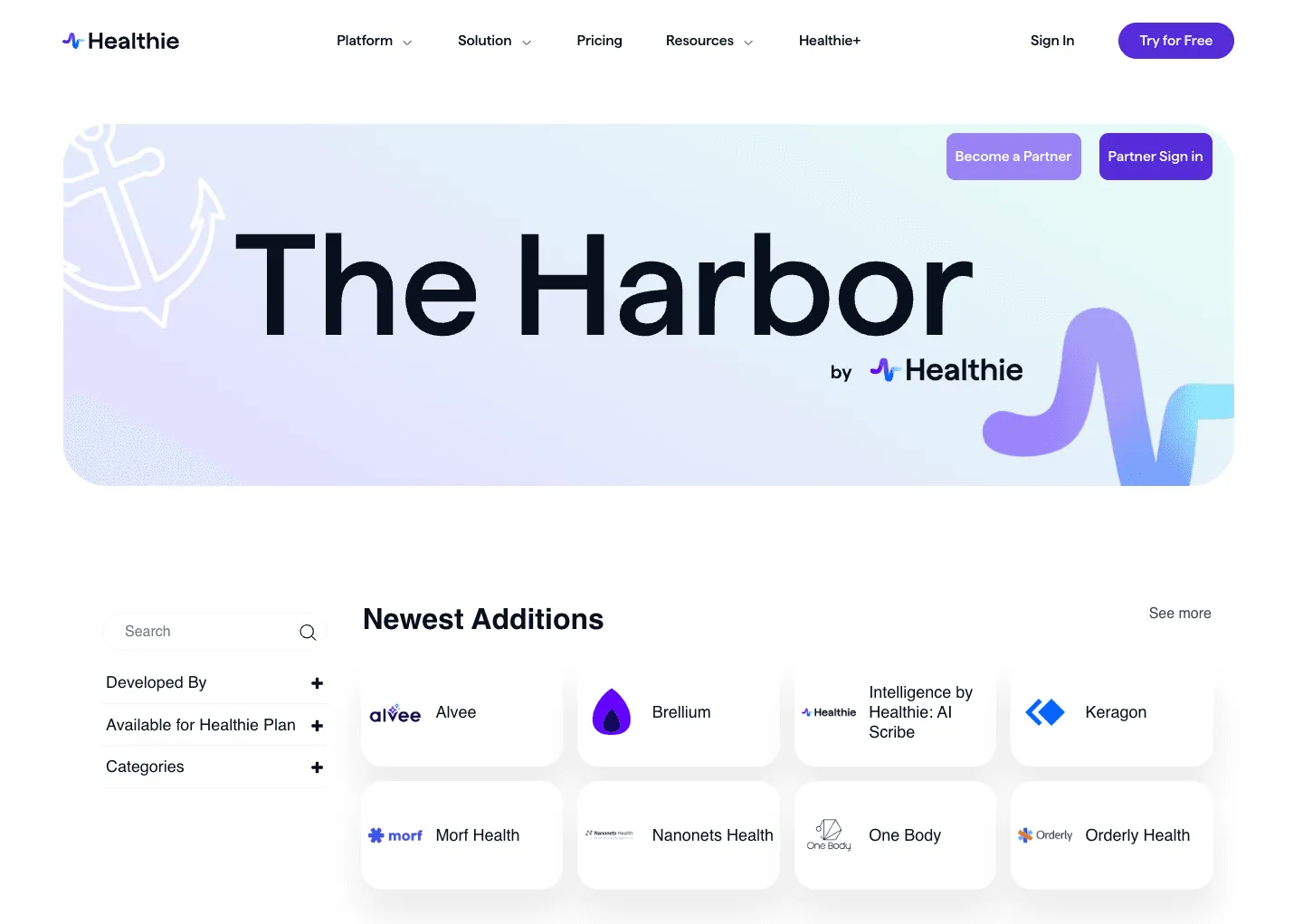
Healthie needed a way to showcase trusted partners, help customers find the right integrations, and support sales and success conversations, without creating ongoing engineering overhead.
By launching their integrations marketplace with Partner Fleet, they turned integrations into a shared asset across product, partnerships, sales, and customer success. Listings stayed current. Discovery improved. And partners could clearly communicate how they complemented Healthie’s platform.
The outcome wasn’t just more integrations. It was a healthier ecosystem that worked for customers, partners, and internal teams alike.
How to scale your marketplace without slowing product
The teams that scale integrations fastest all make the same shift in thinking.
- Treat the marketplace as a product surface
Integration discovery and adoption deserve the same care as your core UX, because they directly impact retention and expansion. - Use APIs to unlock the long tail
Your team builds stable, secure APIs. Partners and third parties use them to serve niche workflows, specialties, and edge cases you’ll never prioritize internally. - Centralize ecosystem management
Marketplaces break down when listings live in docs, tickets, and tribal knowledge. A dedicated system keeps discovery, ownership, and measurement in one place.
This model turns integrations from a drag on velocity into a force multiplier for your platform.
Getting started
If you’re early, keep it simple:
- Identify the integrations customers ask for most
- Define what “good discovery” looks like for your buyers
- Choose infrastructure that reduces engineering lift from day one
You don’t need perfection. You need momentum.
A health tech integrations marketplace isn’t just technical infrastructure. It’s a signal that your platform is built to plug into the real world of healthcare systems, data, and workflows.
If you want to scale integrations without scaling headcount, expand into niche use cases, and show up as a platform instead of a point solution, it’s time to rethink how you approach your ecosystem.
Ready to build a health tech integrations marketplace that grows with you?
Book a demo and see how Partner Fleet helps teams launch faster, scale smarter, and keep product focused where it belongs.
Get a demo
Keep reading
Browse all posts
How Phenom turned 200 idle partners into $500K+ in partner program revenue
How Phenom built a tiered partner program and earned $500k+ in partner program revenue in under one year.

Partner Fleet launches In-App Marketplace, bringing integration adoption inside the product
The new module gives companies a conversion-optimized integration experience for their customers, plus the analytics to prove what integrations are worth.

Partnerships in 2026: Retention is the real growth lever
Get it right early, and you'll have a great year.