
How to co-market with any partner size (without burning out your team)
Grab your notebook: this is a long one

Co-marketing is one of those ideas everyone nods along with in strategy meetings, then quietly drops when the calendar fills up with “must ship” campaigns.
You know it can work. A good partner gives you access to a warm audience, credibility you did not have yesterday, and more pipeline than your team could create alone. A bad partner soaks up time in shared docs and “quick syncs” that go nowhere.
The difference is rarely just the idea. It is how you pick partners and how you show up based on who is bigger, smaller, or roughly your size.
This guide breaks co-marketing down by partner size so you can choose plays that fit the relationship: what to do with smaller partners who want your help, peers who can truly collaborate, and larger platforms or hyperscalers where you are the small fish. Use it as a menu, not a checklist. Pick a few plays per bucket and run them well, instead of saying yes to everything and shipping nothing.
Quick recap: why this lens matters
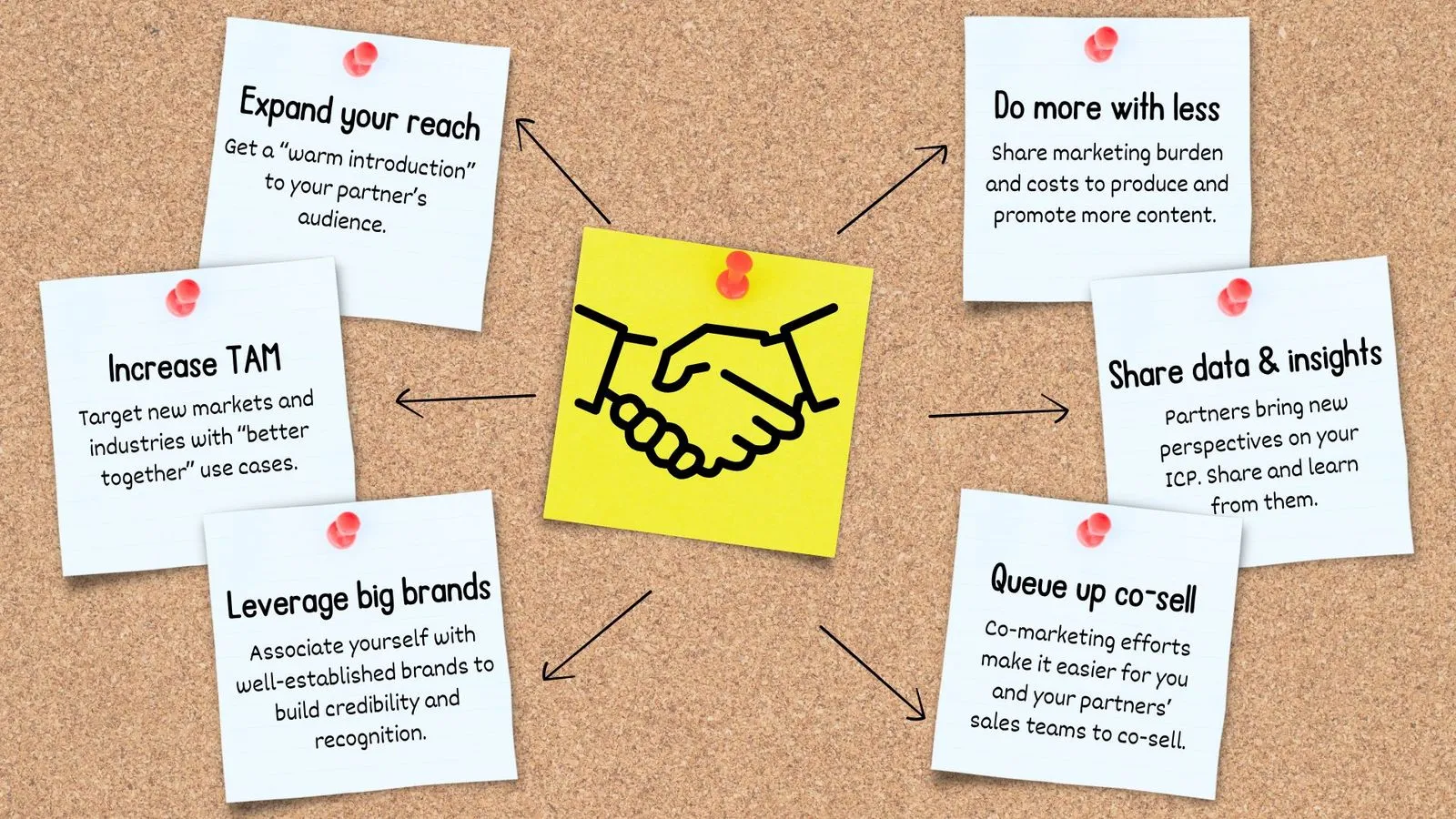
The ideas in this post come from a discussion with Sienna Quirk (prev. CMO, Advisory) and me. Here's why we think this topic matters for marketers:
- Co-marketing is one of the fastest ways for small teams to expand reach and drive pipeline without adding headcount.
- It works best when you are clear on goals, audience, and who actually has time and authority on the partner side.
- You will wear different hats depending on whether you are the smaller partner, equal partner, or bigger partner in the relationship.
So instead of a generic “50 co-marketing ideas” list, I'm going to break things down based on that relative size dynamic. Use it like a menu. Pick a few plays per tier, not all of them at once.
Prefer video to blogs? Here's the recording of our discussion.
Part 1: co-marketing with partners smaller than you
Here, you are the bigger brand or the more mature company. You likely have:
- Better messaging and positioning
- A stronger content engine
- A larger list or bigger social reach
Your job: make it ridiculously easy for smaller partners to promote you and look good doing it. You are not just “doing them a favor.” You are building distribution and turning them into an extension of your marketing team.
1. Run a recurring partner town hall
Format: 30 to 45 minutes on Zoom, monthly or quarterly.
Use it to:
- Share product updates and what they mean in plain language
- Walk through use cases that are easy to sell
- Show new campaigns they can plug into
- Highlight one or two partners and how they won a deal
Record it. Drop the replay in your partner hub, Slack, or portal. The real win is consistency. One town hall is an event. A recurring town hall is a channel.
2. Build and maintain swipe files they actually use
One of the most tangible ways to support smaller partners is to give them ready-to-use content:
- Social posts they can copy and paste
- One or two simple email templates
- A one page overview they can send to clients
- A few slide templates for pitches
Do not overcomplicate this. A Google Doc, Notion page, or “Partner Assets” section in your partner marketplace or partner portal is enough. The important part is that you refresh it regularly instead of dropping a PDF once and forgetting it.
If you build this into your process, every time you launch a new campaign you ask, “What is the partner version of this?”
3. Run a “multi partner feature” instead of one offs
Smaller partners often feel like they will never make it to your content calendar. Solve that by grouping them:
- A “partner spotlight” blog that highlights 3 to 5 partners by vertical
- A monthly “partner stories” section in your newsletter
- A “recommended partners” block in your product onboarding emails
This lets you share the workload and spread the love without promising each partner their own bespoke campaign.
4. Put smaller partners directly in front of your customers
You do not have to choose between “customer content” and “partner content.” Blend them.
Ideas:
- Invite partners to join customer training webinars and show a short “how we help” segment
- Co-host office hours with a partner, focused on a shared use case
- Have partners guest in your customer community, Slack, or forum to answer questions
You get more relevant content. They get credibility and exposure. Customers get more complete solutions instead of random names in a PDF.
5. Let them own their listing in your marketplace or directory
If you have a marketplace or partner directory, use it.
- Invite smaller partners to create and maintain their own listings
- Give them a clear framework for messaging: who they serve, what problems they solve, how you work together
- Encourage them to add case studies that mention both your product and theirs
This is one of those “do the work once, benefit forever” plays. They update their listing, you benefit from fresher content and better enablement for your team and your customers.
If you are using something like Partner Fleet, this can also power your internal enablement. The same listings that live on your public marketplace can feed an internal enablement hub for sales. So those smaller partners become searchable, not just a logo on a slide.
Need a marketplace with a partner login?
Get a demo of Partner Fleet's out-of-the-box partner marektplace platform.
Talk to us
6. Offer co-branded collateral that scales
Instead of custom PDFs for every partner (which never scales), set up:
- A standard one pager template with a slot for partner logo and a short value statement
- A simple “better together” slide with room for their messaging
- A case study layout that can be reused
The trick is to own the template. Then either:
- Let partners personalize within controlled fields, or
- Have your team drop in their details in a 15 minute working session
The partner gets something polished. You control the story.
7. Help them market your product locally or in niche segments
Smaller partners often have incredible niche reach. They know a region, a micro vertical, or a specific buyer persona better than you ever will.
You can:
- Co-sponsor a webinar or meetup for “their” niche
- Give them a mini budget to run ads or host a small event, but with your best practices and guardrails
- Build a very specific use case campaign together, like “how X agency uses Y product for dental practices”
You provide the frameworks, content, and brand. They bring the audience and trust.
8. Say no on purpose
A very real part of co-marketing with smaller partners is choosing who not to work with right now.
Ask:
- Are they sending the right kind of leads?
- Do they have capacity to actually execute on what you plan?
- Do they have the right stakeholder involved, or is it all “vibes” from a junior contact?
It is fine to keep some partners in a light touch referral bucket and reserve heavier co-marketing for the few that can truly move the needle.
You are allowed to protect your team’s time. In fact, you should.
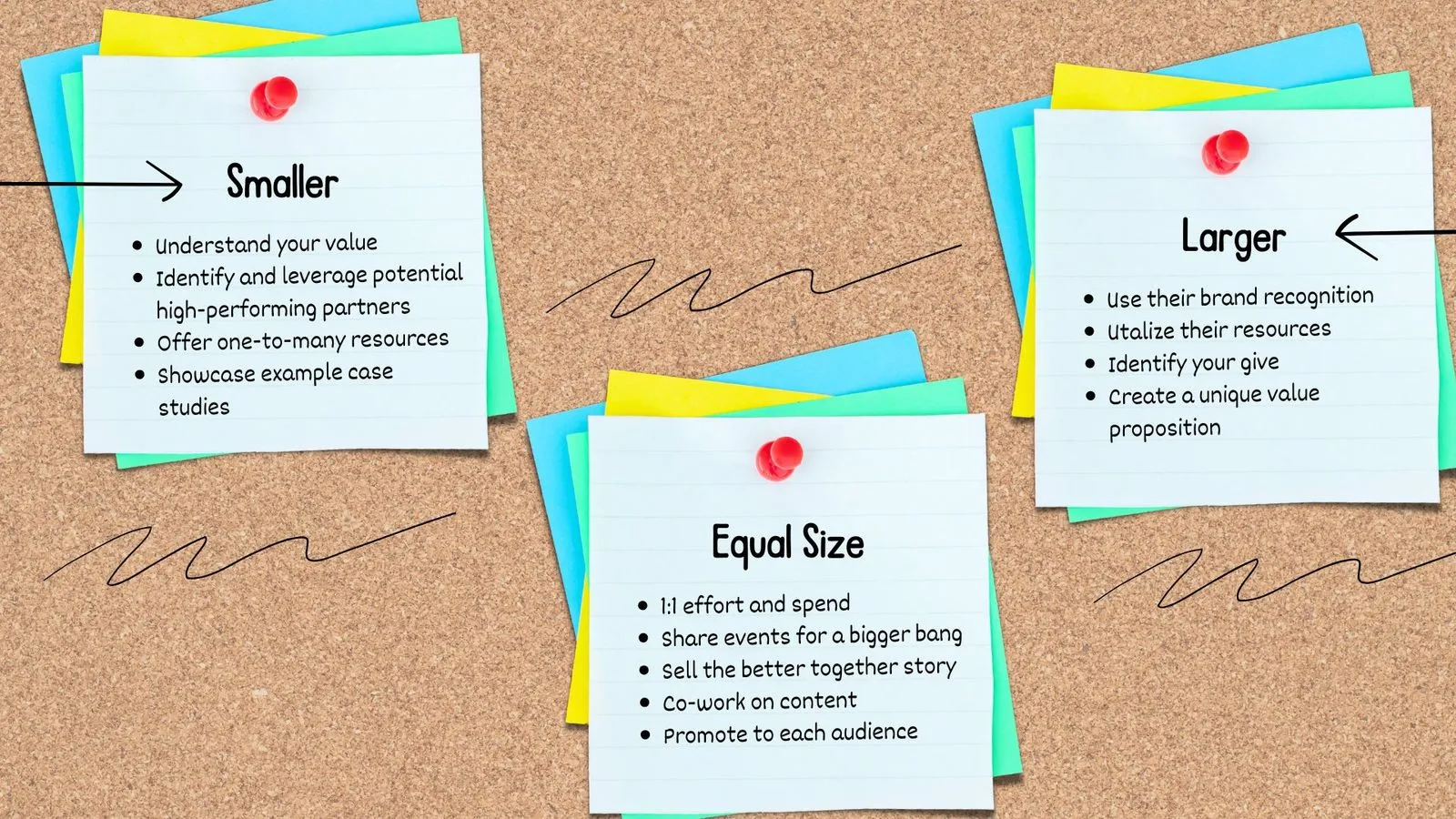
Part 2: co-marketing with partners your size
This is where it gets fun. You are both in growth mode. You both need pipeline. You both have small teams.
Here, the mindset shifts from “I am enabling you” to “We are building something together.”
9. Do a true joint webinar or live session
Not the boring “two vendors reading slides” format. Aim for something conversational and useful, like:
- A tactical playbook session where you both share how you solved a problem from your angle
- A customer panel where you bring a joint customer who uses both tools
- A mini workshop where you co-build a framework in real time
Key points:
- Decide one clear audience and one clear outcome.
- Share the prep work: you should not be writing all the copy while they just “approve it.”
- Align on promotion plans. Each side should commit to a minimum number of sends or posts.
If you record it, you can turn it into blog content, snackable clips, sales enablement, and follow up campaigns.
10. Swap content that feels native, not forced
You do not have to co-author everything. Sometimes the fastest play is a content swap:
- You write a guest post for their blog that speaks directly to their audience’s problem.
- They send a feature of your guide in their newsletter and you do the same for theirs.
- You trade podcast guest spots or video interviews.
The trick is to write for their audience, not yours. Think of it like borrowing someone’s room. You do not rearrange all the furniture. You just bring something that fits.
11. Turn events into full funnel campaigns, not one night stands
A lot of companies either:
- Only do digital co-marketing, or
- Only do physical events around conferences
The highest leverage is when you connect the two.
Example:
- You and a partner decide to co-host a dinner or happy hour around a big industry event.
- Ahead of time, you co-create a short guide or playbook on a relevant topic.
- You use that content to invite people to the event.
- At the event, you reference the content and offer a deeper dive.
- After the event, you send a recap with the guide and a joint CTA.
You just turned one night of “drinks with logos” into something that drives actual meetings and pipe.
12. Do joint lunch and learns for your own teams
Internal co-marketing is as important as external.
Set up cross-company sessions where:
- Their sales and CS teams learn how to position your product
- Your teams learn how to spot and pitch theirs
- You walk through joint use cases and common objections
This is especially powerful if you already have joint customers. Use real stories. “Here is how Acme uses us together to reduce X by Y.”
Your co-marketing becomes co-selling fuel.
13. Launch a “better together” story, not just a logo trade
If you have an integration or a very clear connection between products, treat it like a mini launch.
You can:
- Co-create a single “better together” landing page
- Write a deep dive blog for each of your audiences
- Record a 3 to 5 minute demo showing the workflow
- Arm both teams with a one pager and email templates
Even if you do not have a direct integration, you might have a joint use case. Frame it as “when to use us together” instead of “we are buddies.”
14. Create a recurring series, not one off noise
One-off webinars disappear in inbox history. A series builds anticipation and brand.
Ideas:
- A quarterly “state of [your niche]” session with your partner
- A “playbook series” where each episode covers a specific problem, alternating who hosts
- A regular joint column on LinkedIn or your blogs where you trade perspectives
It also makes it easier to say no to random requests. Instead of “sure we can do a webinar someday,” you can say, “We have a series. Here is the theme and format. Does this fit?”
15. Co-market around customer stories, not your feature lists
Your best co-marketing assets are joint customers.
Build campaigns like:
- A case study told from the customer’s perspective, featuring both solutions
- A webinar or live AMA where that customer shows their actual setup
- A written “field guide” that breaks down their stack and process, with quotes
You get proof that your partnership benefits real people. That is easier for leadership to support and for sales to use.
Part 3: co-marketing with bigger players and hyperscalers
This is the “we are the small fish” side. Think Salesforce, AWS, Azure, GSIs, or any significantly larger platform or partner.
Here, you have two non-negotiables:
- Be very clear on your unique value to their ecosystem.
- Be prepared to do more of the work.
16. Build internal stories that help their reps win
Big partner programs are flooded with vendors. Their sales teams will not remember you because you exist. They will remember you because:
- You make them more money
- You help them close specific deals
- You give them a simple story they can repeat
Co-marketing here can look like:
- Win summaries that explain how you helped close a deal together
- One page “how we help your reps” guides
- Short Loom videos showing the use case
You can also package these stories for external use, but the first audience is internal.
17. Use pay to play carefully, but strategically
Many large platforms have marketing programs you can buy into. Things like:
- Sponsored social posts
- Featured marketplace placements
- Co-branded ebooks or webinars
On their own, these can get expensive fast. Paired with strong stories and clear ICP focus, they can be the accelerant.
Before you say yes:
- Confirm the audience segment and reach.
- Align with your sales team on how they will follow up.
- Set a clear success metric, not just “brand.”
18. Pitch content that fits their editorial goals
Big players often accept content submissions from partners, even if they do not advertise it loudly.
You can:
- Pitch a guest blog that speaks to a pain point their customers have
- Offer a “how we solved X using [big platform] plus [your product]” story
- Share data or insights that make them look smart
This is not where you push your brand hard. This is where you show you understand their audience and add value.
Your advantage as a smaller company is speed. You can write and ship faster than most large marketing teams.
19. Turn marketplace presence into a campaign, not a listing
If you are on a cloud marketplace or big partner directory, treat it like a launch:
- Refresh your listing with clear outcomes and social proof
- Run a campaign to your own audience about “now available on X marketplace”
- Co-create a short explainer for how to buy through that marketplace
- Ask your partner manager what co-marketing levers are available at your tier
Many teams assume “we are live on the marketplace” is the finish line. It is actually the starting gun.
Want to build your own marketplace
Get our comprehensive checklist on what to include.
Download the checklist
20. Co-sponsor events around their flagship moments
You may not be able to afford a giant booth at their conference. You can still capitalize on it.
Ideas:
- Host a side event with one or two other partners that share your ICP
- Run a virtual “what we learned at [big event]” session right after, and invite their customers
- Create a specific offer for attendees, such as a free assessment or quickstart template
The big platform does the heavy lift of drawing the audience. You ride the wave.
21. Architect “better together” plays for their ecosystem, not just your product
Your pitch should not be “please promote us.” It should be “here is how we help your customers adopt your product more deeply, expand faster, or reduce churn.”
Then your co-marketing assets look like:
- Joint reference architectures
- Vertical specific guides, like “Financial services playbook with [big platform] and [you]”
- Recorded demos that show the full flow on their platform
This is the bridge between co-marketing and co-selling. Marketing helps tell the story. Sales uses it to drive deals.
Part 4: how to prioritize partners so you do not drown
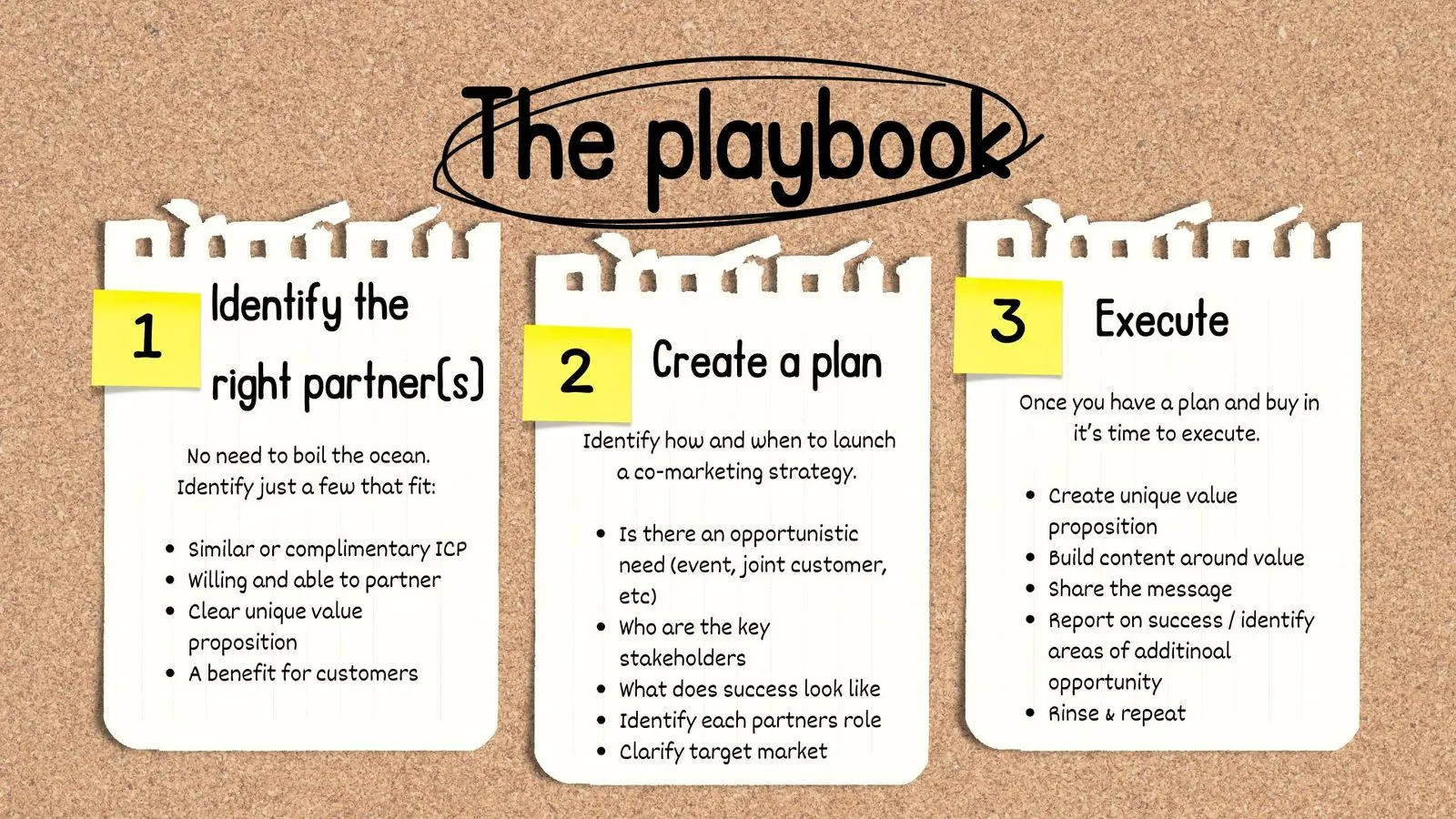
This is the part where most co-marketing motions fall apart. The ideas are not the hard part. Focus is.
Here is a simple workflow you can steal.
Step 1: brain dump every possible partner
List all:
- Integration partners
- Agencies, SIs, and consultants
- Influencers and thought leaders
- Cloud marketplaces and large platforms
- Existing referral partners
Dump it into a spreadsheet. Do not edit yet.
Step 2: add three fields
For each partner, quickly note:
- Goal fit
Can this partner help you drive the specific outcomes you care about this quarter? Pipeline, new logo acquisition, expansion in a vertical, etc. - Audience overlap
Do they sell to your ICP, or is it a stretch? The best partners sell to your ICP every day. - Resource fit
Are they resourced and empowered to act? Is your contact senior enough to say yes to a campaign? Do they have marketing support at all?
Use a light scoring model if you want, but do not get lost in formulas. You just need enough signal to compare.
Step 3: define two categories
From there, break your list into:
- Quick wins
People you already have a relationship with, who will reply fast, and where a simple play (webinar, content swap, joint email) can go live in 30 to 45 days. - Big bets
Higher impact partners that may require more ramp time, internal selling, and coordination. Think cloud marketplaces or big brands.
You are going to run both. Just not at the same volume.
Step 4: explicitly name the “not now” group
Do yourself a favor and name the group that is not worth co-marketing with right now.
Reasons:
- They send the wrong kind of leads.
- They want a lot of attention but cannot move deals.
- They are lovely humans but misaligned on ICP or motion.
- Your main contact is enthusiastic but has no authority or resourcing.
You can still keep a light referral relationship or marketplace listing. You just do not build layered co-marketing plays around them yet.
Step 5: start small and build your playbook
For your first wave, pick:
- 2 to 3 smaller partners
- 2 to 3 peers
- 1 big bet
For each bucket, choose one primary motion, not five.
Example:
- Smaller partners: town hall plus swipe files.
- Peers: joint webinar plus conference side event.
- Big bet: marketplace listing refresh plus one internal win story.
Run those well. Document your process. That becomes your Playbook.
Once you can show that it works, you rinse and repeat with more partners instead of reinventing everything every time.
Part 5: what to measure so you can keep your headcount
Partnership and co-marketing always feel good. That is not enough.
If you want to keep or grow partner headcount, you need to move from “it feels like this is working” to “here are the numbers.”
A simple, marketer friendly measurement set:
- Top of funnelNew leads sourced from partner campaignsNew names added to your list by partnerContent engagement: webinar signups, attendance rate, on demand views
- Pipeline and revenueOpportunities sourced or influenced by each partnerWin rate of deals with partner involvement vs withoutTime to close when a partner is engaged
- Channel healthNumber of active co-marketing partners (not just signed agreements)Number of campaigns per quarter by tier (smaller, equal, larger)Cycle time from idea to launch
You do not need a perfect attribution model to start. Tag campaigns clearly, track partner involvement in your CRM, and review the data regularly with leadership.
The story you want to be able to tell is:
“We ran X co-marketing plays across Y partners. That created Z pipeline, and here are three specific deals that closed because of it.”
That protects your team when budget conversations get tense.
Bringing it back to your day job
If you are a marketer, you probably wear more hats than your job description admits. Co-marketing can feel like “one more thing.”
The point of this guide is not to add complexity. It is to:
- Give you a structured way to think about partners by size and role
- Hand you a menu of plays for each bucket
- Help you prioritize so you are not chasing every shiny logo
If you have a partner marketplace, developer portal, or partner directory, a lot of this becomes much easier. Partners can:
- Own their listings
- Access swipe files and collateral
- Be discovered by your team and your customers without another slide deck
- Plug into co-marketing motions in a repeatable way
That is the world Partner Fleet lives in. If you want to turn co-marketing from “ad hoc favors” into a repeatable growth channel that works across smaller partners, peers, and hyperscalers, that is exactly what we help teams do.
You bring the partners and the ideas. We give you the marketplace and enablement layer to scale it.
If that is on your roadmap, this is your nudge to book a demo now, while you are already thinking about who you want to co-market with next.
Frequently asked questions
- Co-marketing is when you and a partner run shared campaigns to reach each other’s audiences. Your approach should change based on whether the partner is smaller, similar in size, or much bigger, because expectations, resources, and leverage are different in each case.
- Focus on making it easy for them to promote you: provide swipe files, simple co-branded collateral, recurring partner town halls, and give them strong listings or visibility in your marketplace or directory.
- With peers, run true joint webinars, content swaps, event campaigns, and “better together” stories; with big platforms or hyperscalers, lean into internal enablement for their reps, strategic marketplace campaigns, and content that makes their ecosystem look stronger.
- Prioritize partners by goal fit, audience overlap, and resource fit, then focus on a small set of quick wins and big bets. Track leads sourced, pipeline and revenue influenced, win rates, time to close, and the number of truly active co-marketing partners.
Keep reading
Browse all posts
How Phenom turned 200 idle partners into $500K+ in partner program revenue
How Phenom built a tiered partner program and earned $500k+ in partner program revenue in under one year.

Partner Fleet launches In-App Marketplace, bringing integration adoption inside the product
The new module gives companies a conversion-optimized integration experience for their customers, plus the analytics to prove what integrations are worth.

Partnerships in 2026: Retention is the real growth lever
Get it right early, and you'll have a great year.