
From EHR integrations to patient workflows: designing a scalable health tech partner ecosystem
EHR integrations don’t create outcomes on their own. Workflows do.

If you work in health tech, you’ve probably had this conversation more times than you can count.
A prospect asks about EHR integrations almost immediately.
Sales flags it as a deal requirement.
Product starts mapping dependencies and timelines.
Before long, the ecosystem conversation turns into a familiar checklist:
Which EHRs do we integrate with?
Do we support Epic? What about Cerner?
Is this on the roadmap, or do we already have it?
That focus makes sense. EHR integrations are unavoidable in health tech. But they’re also where many ecosystems quietly stall, even when the integrations themselves are solid.
The reason is simple. EHR integrations don’t create outcomes on their own. Workflows do.
EHR integrations are necessary, but they’re not a strategy
Let’s be clear. Integrating with major EHRs like Epic or Cerner is table stakes.
Without them, you can’t reliably access patient data.
You struggle in regulated environments.
You raise red flags with buyers before the conversation even gets interesting.
At the same time, these integrations are expensive to build, slow to evolve, and difficult to maintain. They also tend to look very similar across vendors. Everyone has to play by the same rules.
So while EHR integrations are essential, they’re not where differentiation happens.
You don’t win deals because you have an EHR integration.
You lose deals because you don’t.
Once that baseline is met, buyers move on quickly. And that’s where things start to change.
What customers actually ask for after the EHR conversation
Once data is flowing, customers stop talking about systems and start talking about problems they’re trying to solve.
They ask about patient intake and onboarding.
They ask about scheduling and reminders.
They ask about remote monitoring, care coordination, specialty workflows, reporting, compliance, and analytics.
None of those are single integrations. They’re workflows. And workflows almost always span multiple tools.
This is where many health tech teams run into a hard constraint.
You cannot build every workflow your customers need without dramatically expanding scope, headcount, and long-term maintenance costs. At some point, the platform starts to feel less like software and more like a services organization in disguise.
That’s the moment partner ecosystems stop being optional.
Why long-tail integrations show up so fast in health tech
Health tech ecosystems have a particularly sharp long tail.
Specialties operate differently from one another.
Regulations change by region and care model.
Buyers range from solo providers to massive health systems.
Procurement pulls in clinical, IT, compliance, and finance teams.
All of that produces a steady stream of highly specific integration requests. Many of them are valid. Most of them are hard to prioritize.
Early on, teams tend to respond reactively. They build custom integrations for large customers, strike one-off partner deals, document things internally, and move on. Over time, some of those integrations become critical, but they remain poorly surfaced and inconsistently maintained.
The ecosystem grows, but it grows sideways.
Internally, it becomes harder to track what exists and who owns it. Externally, buyers struggle to understand what’s actually supported. Risk increases, even if the number of integrations goes up.
How common is this problem, really?
We surveyed 100+ B2B SaaS companies and found that most health tech teams struggle to scale long-tail integrations beyond core EHRs, especially when workflows span multiple tools.
Get the report
Designing for workflows instead of chasing integrations
Teams that scale don’t try to out-build the long tail. They reframe the problem.
Instead of asking, “What integrations do we support?” they ask, “What workflows should our platform enable, and who helps complete them?”
That shift changes how the ecosystem is designed.
Partners get grouped by outcomes, not just categories.
It becomes clear what’s native versus partner-built.
Listings are curated around real use cases instead of dumped into a directory.
New integrations can exist without creating engineering bottlenecks.
At this point, ecosystem structure becomes part of the product strategy, not just partner marketing.
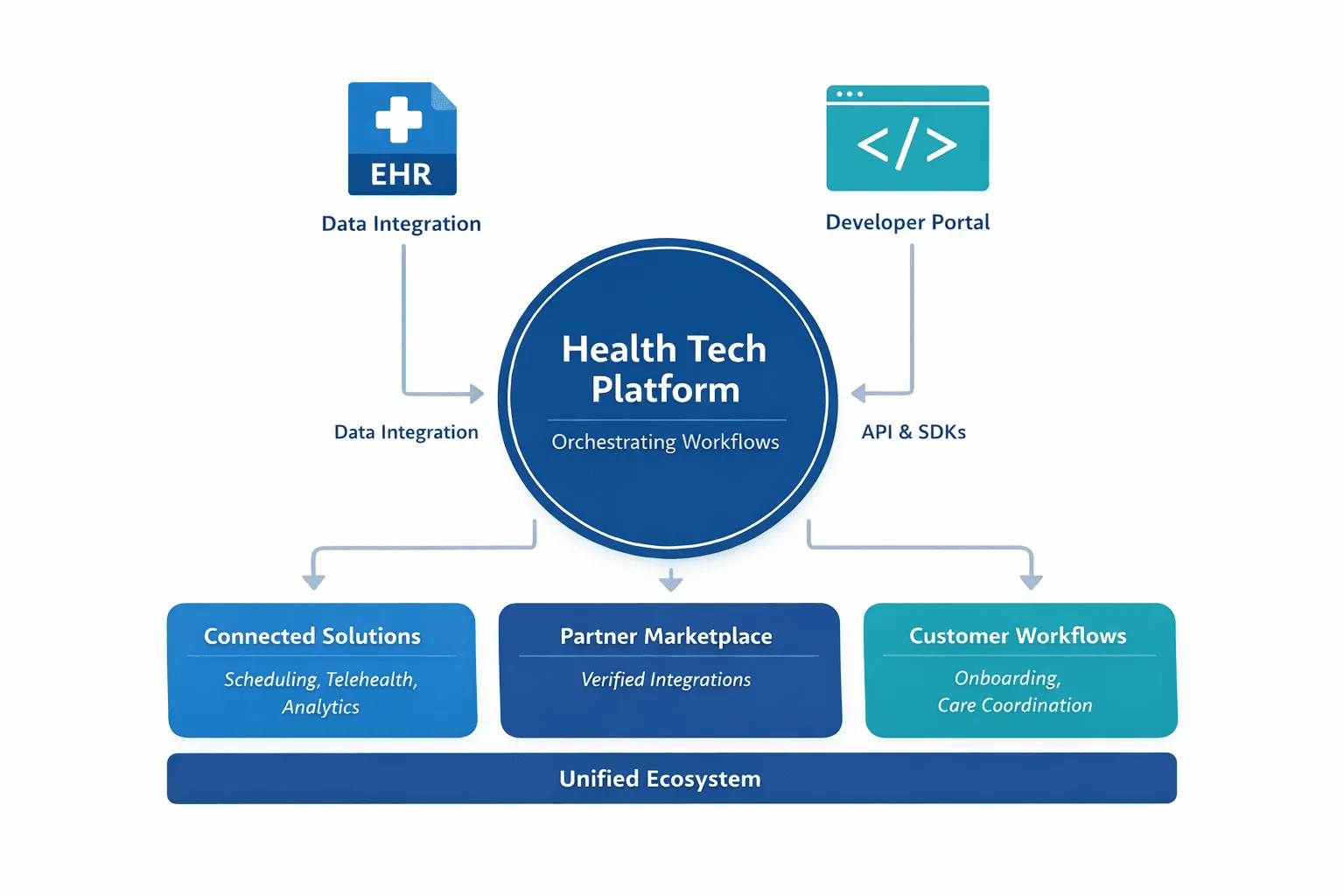
The marketplace as a trust surface, not a list of logos
In health tech, visibility drives trust.
Buyers want to know what integrations exist, who owns them, how mature they are, and whether they’ll be supported over time. When that information isn’t clear, deals slow down, even if the integrations technically exist.
A partner marketplace should function as the public contract of your ecosystem. It should show supported workflows, give sales and success teams something concrete to point to, and present partners professionally.
This is where Partner Fleet fits naturally.
Instead of acting as a static directory, the marketplace becomes a living surface. Integrations are organized around workflows and use cases, content stays consistent across public and in-product views, and the ecosystem can evolve without constantly re-explaining itself.
Why a developer portal is the other half of the equation
Most health tech companies say they support third-party developers. In practice, many don’t design for them.
API documentation lives in one place.
Build processes are unclear.
There’s no obvious submission path.
Quality control happens manually, if at all.
That approach doesn’t scale. It just pushes work behind the scenes.
A real developer portal changes the operating model. It makes APIs discoverable, gives external developers a clear path to build and submit integrations, and ties that work directly into marketplace listings. Standards exist, but innovation isn’t blocked.
This is how long-tail integrations get built without overwhelming your core team.
When the marketplace and developer portal work together
The real unlock happens when these two surfaces are connected.
Partners know how to build.
Developers know where to publish.
Customers know what’s available.
Internal teams know what exists and who owns it.
At that point, the platform stops feeling like a bottleneck. It starts acting as an orchestrator.
What this means for health tech teams
Building a health tech ecosystem isn’t about integrating with everything.
It’s about anchoring on EHRs for credibility, expanding through partners for workflow depth, designing trust and visibility into the ecosystem, and letting long-tail innovation happen without chaos.
That takes intention. Not just integrations.
Partner Fleet gives health tech teams the marketplace and developer portal infrastructure to do this deliberately, instead of letting the ecosystem grow unchecked.
If you’re ready to move beyond integration checklists and design an ecosystem around real patient and provider workflows, that’s the shift worth making.
Build a scalable ecosystem
Explore how a connected marketplace and developer portal unlock workflow coverage at scale.
Get a demo
Keep reading
Browse all posts
Partner Fleet launches In-App Marketplace, bringing integration adoption inside the product
The new module gives companies a conversion-optimized integration experience for their customers, plus the analytics to prove what integrations are worth.

Partnerships in 2026: Retention is the real growth lever
Get it right early, and you'll have a great year.

How Mindbody built the #1 integrations marketplace in fitness tech
A powerhouse company with a powerhouse marketplace.